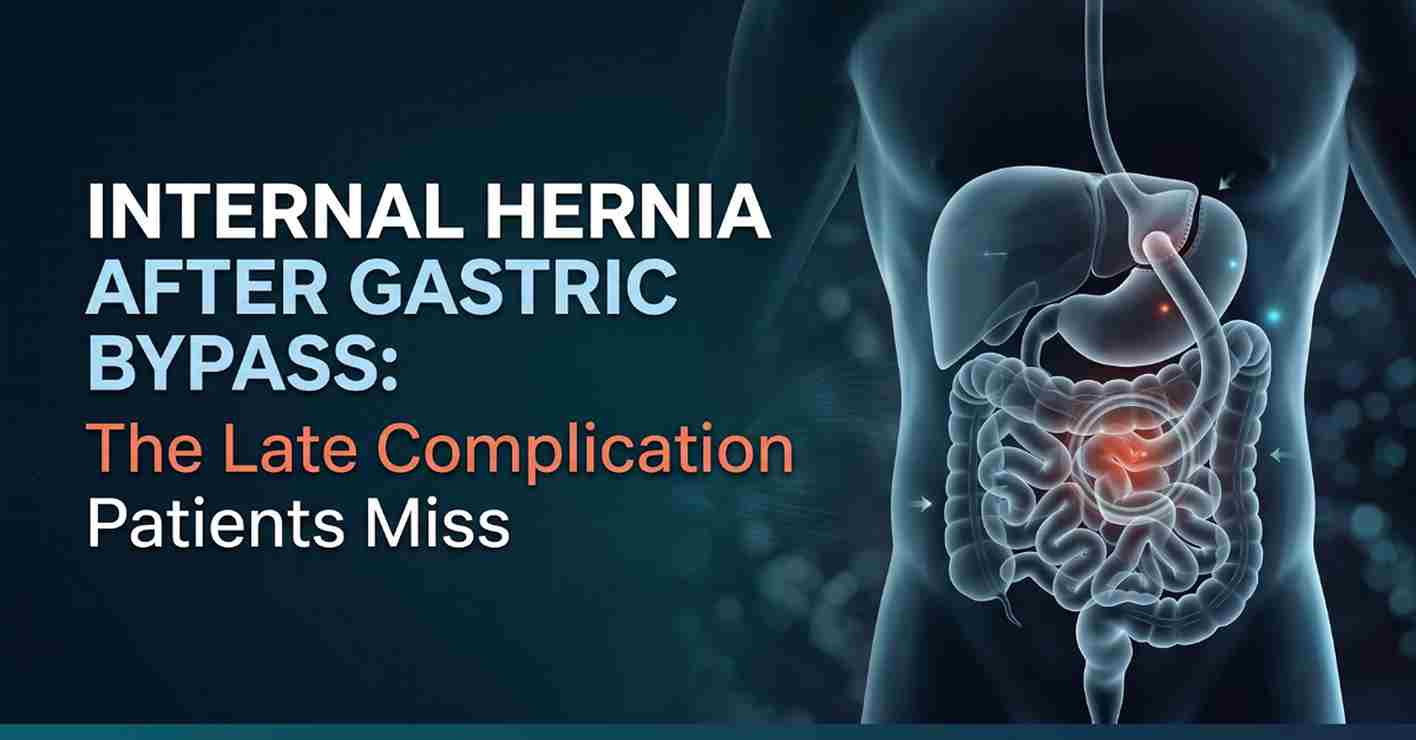
Internal hernia after gastric bypass is when a segment of your intestine slips through a gap formed inside your abdomen during surgery.
You could experience intermittent abdominal discomfort, postprandial cramping, nausea, or changes in bowel habits. Others feel fine initially but develop abrupt, intense pain months or years later.
To assist you in catching danger early, the following sections detail causes, symptoms, diagnostics, and treatments.
Key Takeaways About Internal Hernia After Laparoscopic Roux-En-Y
- You’re at a lifetime risk of internal hernia after gastric bypass since the operation alters your anatomy and leaves new spaces that small intestine loops can move around in. These hernias occur internally, inside your abdomen, and can rapidly become life threatening.
- You’re at higher risk for an internal hernia if mesenteric defects are not completely closed, you lose weight quickly, have particular surgical techniques, or have revision surgeries. You can inquire with your surgeon how your surgery was conducted and how they addressed these spaces.
- You should be vigilant for symptoms like intermittent or acute abdominal pain, nausea, vomiting, bloating, or constipation, particularly if they become worse after meals or movement. Even vague or mild symptoms after gastric bypass warrant attention because they could be the early signs of a hernia.
- You require emergency medical attention if you experience sudden severe abdominal pain, persistent vomiting, fever, or any sign of shock including low blood pressure or a rapid heart rate. Prompt diagnosis and management mitigate bowel ischemia, necrosis, and the risk of fatality.
- You can anticipate your physician to employ your history, physical, and imaging, typically a contrast-enhanced CT scan, to search for an IH. In others, you’ll require diagnostic laparoscopy so doctors can directly visualize and address the problem.
- You can reduce your risk and safeguard your health by attending all follow-up visits, immediately reporting new abdominal symptoms, and following your postoperative plan. Being in tune with your health and working with your bariatric team helps you detect and act quickly should a hernia develop.
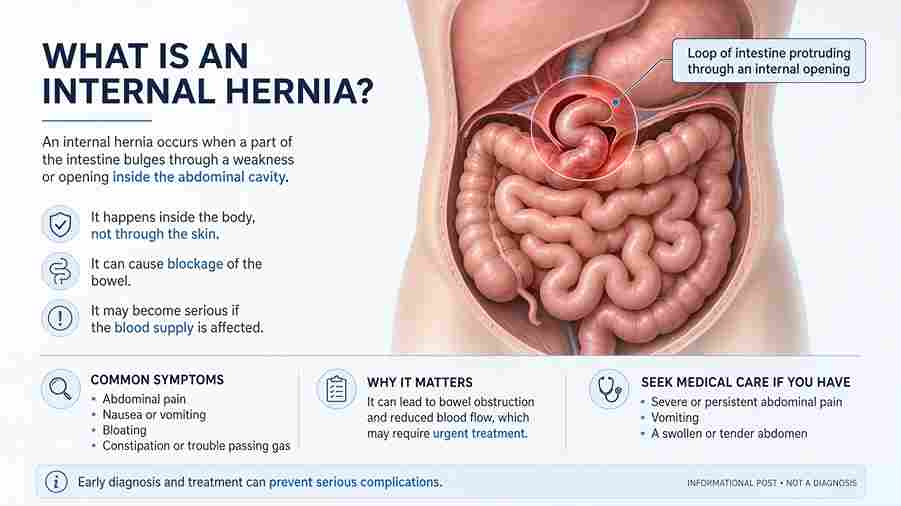
What Is An Internal Hernia?
An internal hernia is when a portion of your intestine or other internal organ protrudes through a hole or gap (a “defect”) in the thin tissue that attaches your bowel in place, named the mesentery or peritoneum. After gastric bypass, this typically refers to a loop of your small bowel slipping through a surgical opening deep inside your abdomen, not through the skin.
It is among the most significant long-term problems after laparoscopic roux-en-Y gastric bypass and the number one cause of small bowel obstruction in this cohort. If the trapped bowel loses its blood supply, it can cause bowel ischemia, which can be life-threatening if not treated quickly.
Internal hernias are not like the ones you might notice or feel on the outside of your belly. There is no skin bulge and possibly no obvious sign on the exam. They occur at or near the sites altered during surgery and are more common following laparoscopic surgery than open operations.
1. The New Anatomy Complication Of Hernia After Roux-En-Y Gastric Bypass
Roux-en-Y gastric bypass alters the flow of food and digestive juices through your intestine. Your surgeon constructs a small stomach pouch, then attaches it to a section of small bowel called the alimentary (Roux) limb, while bile and pancreatic juices flow down a separate biliopancreatic limb until the two limbs converge again at a jejunojejunostomy.
These alterations form new tunnels and pockets in which bowel loops can glide and entangle. Typical locations of internal hernias are Petersen’s space, or behind the Roux limb mesentery, jejunojejunal mesenteric defect, and a defect in the transverse mesocolon for retrocolic techniques.
Understanding this ‘new map’ of your intestines is crucial for surgeons and radiologists attempting to interpret pain, scans, and risks post-operation.
2. The Created Gaps
As a result of bypass, your surgeon has to sever and move around the mesentery, which leaves either intentional or unintentional holes. These mesenteric defects can be located on the transverse mesocolon, at Petersen’s space, or near the jejunal mesentery at the jejunojejunostomy.
If these gaps are not completely sealed, or if stitches give way as you shed mesenteric weight and fat, a bowel loop can slip in later. That’s why you can get an internal hernia weeks or years after surgery.
| Gap location | Common hernia type |
| Petersen’s space | Petersen hernia |
| Jejunojejunostomy mesentery | Mesenteric/jejunal hernia |
| Transverse mesocolon | Mesocolonic hernia |
3. The Hernia Types , Management Of Internal Hernia
After gastric bypass, internal hernias usually fall into three groups: Petersen hernias (through Petersen’s space), mesenteric or jejunojejunostomy hernias (through the defect at the join of the two bowel limbs), and mesocolonic hernias (through a hole in the transverse mesocolon).
Your surgical path counts. Petersen and jejunojejunostomy defects become more relevant with an antecolic approach where the Roux limb runs anterior to the colon. In a retrocolic approach, the limb passes through the transverse mesocolon, creating an additional defect and increasing the risk of mesocolonic hernia.
Each has its own CT pattern and typical pain location, but all can cause crampy abdominal pain, nausea, and small bowel obstruction. The interval from surgery to symptoms is wide, ranging from the first week to 3 years or more.
4. The Strangulation Risk, Sensitivity And Specificity Of Internal Hernias
When a loop herniates and twists, blood flow can decrease or cease. This is bowel strangulation, and it transforms an internal hernia from a painful issue into an emergency that can cause bowel tissue to die.
If diagnosis is late, the risk of bowel infarction, peritonitis, sepsis, and death increases dramatically, with mortality reported at over 50 percent once strangulation occurs. CTs are useful, but not perfect.
Sensitivity is approximately 63% and specificity is approximately 76%, which means a ‘normal’ CT does not completely rule out an internal hernia. For this reason, new or recurrent abdominal pain following gastric bypass, particularly with associated vomiting or obstructive symptoms, typically requires prompt surgical evaluation and occasionally laparoscopy to directly visualize the bowel and repair any defect.
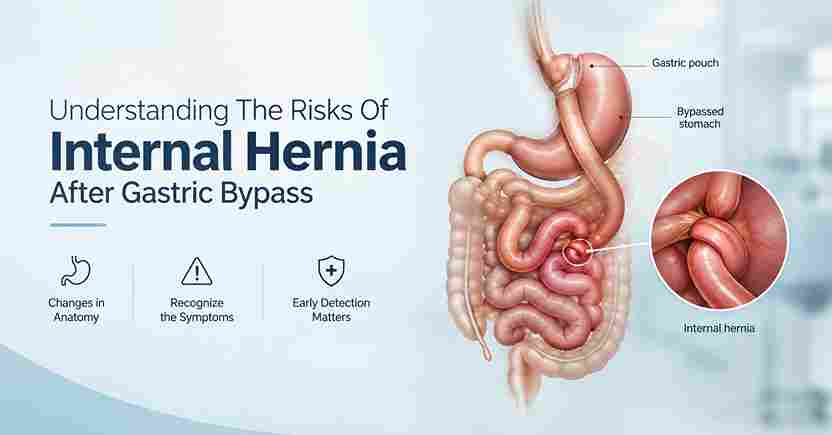
Understanding The Risks Of Internal Hernia After Gastric Bypass
You have a genuine internal hernia risk following gastric bypass, influenced by your surgical technique, your body’s healing process and how rapid your weight loss is. Laparoscopic Roux-en-Y gastric bypass typically has higher internal hernia rates than open surgery, largely due to fewer adhesions to “hold” the bowel in place, so loops of small bowel can slip into spaces more easily. Fast weight loss diminishes the fat in your mesentery, so gaps that used to be taut can now separate over weeks or months.
Surgeon experience, hospital standards and how aggressively teams adhere to closure bundles all factor largely into how likely this is to occur to you.
Surgical Factors And Surgical Treatment Of Internal Hernia
Your hernia risk increases when mesenteric defects are not closed or are inadequately closed. These are the man-made openings created when the surgeon cuts tissue to reroute your intestine, and if they remain open or become loose later, bowel loops can slip through and twist. That’s why defect closure with extreme attention to detail is no longer an option for many centers.
If your Roux limb is behind the colon (retrocolic) rather than in front (antecolic), you’re more likely to have a mesocolic hernia, where bowel herniates through that hole in the colon’s supporting tissue. Some surgeons eschew retrocolic routing for that reason, while others employ rigorous closure methods and meticulous post-operative monitoring to minimize the risk.
Revisional surgery increases scars, more planes, and usually more defects. The chance of internal hernia goes up every time your anatomy gets rearranged. A hospital’s standardized operating checklists and explicit closure protocols can reduce complication rates by ensuring that every defect is inspected and closed in the same way, regardless of who is on call that day.
Patient Factors
Your profile matters as well. A super high preoperative BMI, combined with significant postoperative weight loss, meaning more than 30 to 40 kg, implies that your mesenteric fat can disappear quickly and transform tight spaces into loose gaps. Previous abdominal surgeries may have induced old defects or left you with mixed adhesion patterns that alter your bowel motility post-gastric bypass.
Pregnancy is a unique circumstance. As your uterus expands, it raises abdominal organs and increases intra-abdominal pressure, which can shove bowel into any hernia openings. This is why new or different abdominal pain in pregnancy post bypass merits immediate evaluation. Other sources of elevated intra-abdominal pressure, such as a bad cough or heavy lifting, can produce an analogous but lesser effect over time.
You recover on your own terms. Some develop rugged scar tissue that holds defects rigid, others create softer tissue that expands. The thing is that how your mesenteric fat is spread at baseline can shift how wide those gaps widen as you lose weight. Age, diabetes, connective tissue disorders, and other conditions can weaken support structures, making you both more likely to herniate and less likely to rebound if bowel strangulation occurs.
Symptoms And Diagnosis Of Internal Hernias
Since internal hernias are the leading cause of small bowel obstruction following laparoscopic gastric bypass, your care team needs to maintain a high suspicion when you present with abdominal pain, nausea, or vomiting. These symptoms can manifest as early as one week post surgery to as late as two or three years later, which can make the connection less apparent for you and even clinicians who do not regularly see bariatric patients.
CT scans are useful but not foolproof. Obvious indicators of internal hernia tend to be overlooked, with a sensitivity of approximately 63% and a specificity of around 76%. A “normal” scan doesn’t consistently exclude it when your history and physical health suggest concern.
If untreated, internal hernia leads to strangulated bowel, and the mortality rate can be more than 50%. Many surgeons will proceed expeditiously to exploration when they strongly suspect it, rather than wait for definitive imaging.

Recognizing The Symptoms Of Internal Hernia
Early recognition is important as an internal hernia can evolve from mild pain to bowel strangulation, with a mortality rate of more than 50% if left untreated. Symptoms vary from mild discomfort to an ‘acute abdomen,’ and the severity of your pain doesn’t necessarily correlate with how risky the hernia is. You can be in only moderate pain and yet have already had blood supply to the bowel compromised.
Therefore, any post gastric bypass concern warrants a thorough evaluation.
Common Signs
You typically experience intermittent or constant abdominal pain, usually located in the upper or middle abdomen. This pain might begin weeks post-op or even two to three years later, as internal hernias can arise at mesocolic, jejunal, or Petersen’s defects at any point during that timeframe.
A lot of them exhibit symptoms of small bowel obstruction. You may be bloated, have ceased flatulence, or gone days without a bowel movement despite still having the urge.
Common signs and symptoms include:
- Intermittent or constant upper or mid‑abdominal pain
- Pain that significantly intensifies following eating or when you lie down, bend, or twist.
- Nausea with or without vomiting
- Bloating, abdominal distension, or a firm, tight belly
- Constipation, reduced gas, or other signs of bowel blockage
Since small bowel loops can migrate into the upper abdomen when an internal hernia develops, your pain may be higher than you anticipate for bowel pain.
Subtle Clues
Certain internal hernias begin with subtle, difficult-to-define symptoms. You might experience a dull ache, intermittent mild cramping, or alterations in food tolerance such as early satiety or sporadic nausea unrelated to your meal.
You may realize you fatigue more quickly, feel “funny,” or have low-grade malaise without temperature. Individually, these symptoms appear minor, which makes them easy to dismiss as normal post-operative recovery, stress, or a change in diet.
In a gastric bypass patient, recurring patterns are significant. Documenting each little complaint, including timing, triggers (meals, position), and duration gives your care team a better shot at recognizing a trend toward internal hernia before it becomes an emergency.
Emergency Alerts
Some symptoms should push you to seek urgent care without delay. Sudden, severe abdominal pain, especially with a rigid, very tender abdomen or pain that spikes when you move or cough, can mean peritonitis or advanced obstruction.
Ongoing vomiting, dark green (bilious) vomit, or no gas or stool passage, along with swelling of your belly, fit acute small bowel obstruction and need same-day evaluation.
If you experience dizziness, faintness, fast heartbeat, or very low blood pressure, your body might be indicating bowel ischemia or infarction, a condition where a section of your bowel is losing or has lost its blood supply.
In these cases, you can’t play it safe and ‘wait and see’. In the hospital, your team will likely order a CT scan, but you should know CT is not perfect: sensitivity is about 63% and specificity about 76%.
When surgeons and radiologists review images side by side and discuss your symptoms, as many as 97% of cases display some abnormal indicator, such as small bowel loops elevated in the upper abdomen, mesentery crossing the transverse mesocolon, or obvious obstruction.
This is why well-defined, precise symptom reporting from you and a low threshold for emergency surgical consultation are critical.

How Doctors Diagnose
You arrive at a diagnosis for internal hernia after gastric bypass from a combination of clinical judgment, exam, and imaging. Because no single test is perfect, they need to stitch a bunch of small clues together and act early to prevent bowel damage.
| Step | What Doctors Do | Why It Matters |
| 1 | Listen to your story and surgery details | Symptoms are vague; history raises suspicion |
| 2 | Examine your abdomen | Finds warning signs of obstruction or peritonitis |
| 3 | Order labs | Looks for infection or inflammation |
| 4 | Get imaging (usually CT) | Main tool to spot internal hernia |
| 5 | Consider diagnostic laparoscopy | Direct view when tests do not give clear answers |
Clinical Evaluation
It’s your history that drives most of the decision-making. They ask when you had gastric bypass, what exact technique, any mesh or closure of mesenteric defects, and prior similar pain. They track how your symptoms start and change: sudden cramping pain, pain that comes in waves, nausea, or pain that feels “too strong” for normal gas or indigestion.
Internal hernia symptoms can be subtle, so they consider almost any new, severe, or persistent abdominal pain after bypass suspicious, even if your vitals are near normal.
On exams, they look for focal tenderness, guarding on palpation, bloating, high‑pitched or absent bowel sounds, and peritonitis. Lab tests can reveal elevated white blood cells or C‑reactive protein. Normal labs don’t exclude it. The secret is a high index of suspicion in any post‑ bypassing patients with abdominal complaints, even if early tests appear only slightly abnormal.
Imaging Studies
CT scan with oral and IV contrast is the primary imaging study. It can demonstrate twisted mesentery (the “mesenteric swirl sign”), crowding or clustering of small bowel, displaced loops sitting high in the abdomen, and SBO.
Data indicate CT has approximately 63% sensitivity and 76% specificity, meaning a “normal” report can’t completely allay worry. In one review, 97% of scans showed some abnormal sign, but prospective radiologists’ diagnoses only got 64%, which means subtle findings slip through often.
| CT Finding | What It Means |
| Mesenteric swirl sign | Twisting of mesentery, strong clue to internal hernia |
| Clustered small bowel | Loops bunched in an unusual spot |
| Loops in upper quadrants | Small bowel where it does not belong after bypass |
| Mesentery crossing transverse mesocolon | Suggests herniation through a mesenteric defect |
| Signs of obstruction | Dilated loops, air‑fluid levels, collapsed distal bowel |
Plain abdominal X‑rays could demonstrate dilated small bowel and air‑fluid levels. These findings are nonspecific and cannot be used to rule in or out internal hernia.
Since radiographic signs are easy to miss, close talk between surgeon and radiologist is valuable. Sharing your surgical map and precise concern often provokes a second, more careful consideration.
If symptoms persist and imaging is inconclusive, most surgeons proceed to diagnostic laparoscopy so they can observe the bowel directly and repair a hernia prior to the onset of strangulation.

Treatment And Repair
You treat an internal hernia after gastric bypass with surgery, not medicine. The aim is to free the trapped bowel, check if it is still healthy, and close the gaps, which are mesenteric defects, so the bowel does not slip through again.
Laparoscopic repair is usually the first choice because it often means less pain, smaller scars, and a shorter stay in the hospital. In some hard or urgent cases, such as when the bowel may be dead or badly twisted, open surgery is safer and faster. Early diagnosis and prompt surgery lower the chance that you need bowel removal and cut the risk of life-threatening problems like strangulation, where mortality can exceed 50%.
Surgical Goals
When you’re in surgery, your team goes step by step to address the hernia and prevent it from returning. First, they carefully push the herniated bowel back where it belongs, attempting not to cause lacerations or further restrict blood flow. This can be tricky if the bowel is very swollen or twisted, so slow and careful maneuvers matter.
Next, they examine and close all mesenteric defects with absorbable stitches so the tissue can grow around them and heal. This encompasses areas such as Petersen’s defect and the jejunojejunostomy mesenteric defect even if those regions appear normal.
They then judge bowel viability. A healthy bowel is pink and moves, while nonviable segments may look dark, thin, or dull and need resection. Leaving necrotic bowel in situ increases your risk for sepsis, prolonged ICU courses, and a return to the operating room.
Surgeons record what they encounter and how, which allows their team to audit cases, modify how it closes defects in subsequent bypass surgeries, and enhance long-term results.
Recovery Path
They do really well when it’s repaired early, usually only a brief hospitalization, sometimes only a few days if there wasn’t any bowel resection. Your complete recovery period is typically around four to six weeks, but it’s highly dependent on your individual healing and how well you adhere to post-operative guidance.
You begin mobilizing once it’s safe, typically walking the hall within 24 hours, as this encourages blood circulation, reduces the risk of clots and alleviates gas pain. Your diet returns in phases, from liquids to soft foods and back to your normal bariatric regimen, depending on how your stomach copes with each.
Once you’re home, you still need to be on the lookout for any pain, bloating, vomiting, or trouble passing gas or stool, which could indicate that the internal hernia has returned. CT scans can miss early signs.
You require transparent directions for wound care, pain management, activity restrictions, and when to access urgent care, say if you have sudden severe abdominal pain, fever, or fast heart rate. Because internal hernias can occur even after a well-performed bypass with closed defects, remaining vigilant to symptoms is one of your best protections.
Prevention Is Key
You minimize your risk of internal hernia the most when prevention begins in the OR and extends into follow-up. Even with highly experienced surgeons, internal hernia rates post-gastric bypass can be anywhere from 0.2 percent to 8.6 percent. So, you want a comprehensive, team-based strategy encompassing surgical technique, hospital protocols, and your own post-surgery role.
Surgeon’s Role
About: Prevention is Key. For you, one of the critical details is whether your surgeon closes all mesenteric defects during your gastric bypass and again during any revisional surgery. These are the ‘holes’ in the tissue that suspends your intestines. If they remain open, bowel can slip through and twist.
A few surgeons still don’t close these spaces, but data indicate this has a price. In a series of 1,047 defects left open, the internal hernia rate was 6.2%, hardly rare!
About: Prevention is key. Good technique means how those gaps are closed. A lot of centers employ absorbable running sutures, which can provide a tight, uniform seal that lasts while your tissues heal and scar down. Surgeons reduce other weak spots.
For example, using blunt-tip trocars can cut port-site hernias to about 0.2% in large groups of patients, which lowers one more possible entry point for bowel. Strong perioperative standards help you push down that door a little further.
Hospitals with transparent bariatric pathways, checklists, and a mandatory ‘final count of all possible areas before case closure’ pick up more issues on the table, not later. When surgeons sign on to quality improvement initiatives, review scans with radiologists, and literally count every internal hernia and reoperation, the patterns emerge early and practice changes.
Patient’s Role
You still have a legitimate role in prevention, primarily by not dismissing warning symptoms. Any new or unusual pain in your upper or middle abdomen, cramping that comes and goes, unexplained vomiting, or pain occurring months or years after surgery should drive you to get care, not “wait it out.
Internal hernias are sneaky and initially can have no test changes, so your history counts. By keeping your follow-up visits, your team has an opportunity to review your weight trend, exam, and any subtle symptoms that you might brush off.
Rapid weight loss or large swings post revision can shift your intestines and increase risk, so your surgeon and dietitian need to know the big picture. Radiologists are important too. When they read your CT or MRI with internal hernia in mind and your doctor communicates your history, the risk of overlooking subtle signs decreases.
You assist by being aware of the fundamental symptoms and dangers. If you had laparoscopic gastric bypass and subsequently develop sudden severe abdominal pain, persistent vomiting, or pain that worsens with eating, you can say you’re concerned about an internal hernia.
That keeps the team’s suspicion high, which is necessary for prompt surgery and for reducing morbidity and mortality following this kind of procedure. Keeping near your nutrition plan, avoiding significant weight gain, and moving your body in a slow, safe, consistent manner all promote better healing and more stable anatomy over time.
Conclusion
You live a real change after gastric bypass. Internal hernias feel scary, but you are not helpless here. You know what it is, how it begins, and which symptoms require rapid attention.
You don’t have to pursue every minor pain. You remain vigilant for intermittent pain, sharp pain, pain with nausea, or pain that just feels “off” for your body. You rely on that gut feeling.
You maintain your follow up visits, inquire with concise questions, and communicate new symptoms promptly. That combination of insight and initiative gives you a real advantage.
As your next step, consult with your bariatric team and inquire how they monitor for internal hernias in patients like you.
Frequently Asked Questions
Can you get an internal hernia years after gastric bypass?
Yes. Internal hernia can occur months or even years after gastric bypass. Weight loss alters the room inside your abdomen, which can allow bowel loops to slide through holes. This is why long-term follow up with your bariatric team is crucial.
What are the most common symptoms of an internal hernia?
You can experience sudden or cramping upper or middle abdominal pain, commonly around the navel. Nausea, vomiting, bloating or pain after meals is common. Pain can be intermittent initially. If the pain is severe or persistent, go to the emergency room.
Is an internal hernia after gastric bypass an emergency?
It may be. If the bowel becomes trapped, blood flow may be compromised. This is known as strangulation and is life-threatening. Call 911 or proceed immediately to the emergency department if you have extreme pain, repeated vomiting, fever, or are unable to pass gas or stool.
How do doctors check for an internal hernia after gastric bypass?
Doctors will inquire about your surgery and symptoms, physically examine your abdomen, and request tests. CT with contrast is the most common test. In certain situations, if suspicion is elevated, they will suggest a diagnostic laparoscopy, or keyhole surgery, to look directly.
How is an internal hernia treated after gastric bypass?
Surgery is the only solution. A mistake occurs when your surgeon shuttles the bowel back into place and closes the internal openings with stitches. This is generally performed laparoscopically. Early treatment reduces the risk of bowel injury and severe complications.
Can you prevent an internal hernia after gastric bypass?
Your surgeon can reduce your risk by closing all possible defects during the initial procedure. You can assist by maintaining follow-up visits, reporting new abdominal pain promptly, and adhering to diet and activity instructions as your team recommends post-surgery.
When should you call your bariatric surgeon about abdominal pain?
Call if you have new, recurrent, or unexplained abdominal pain, particularly with nausea, vomiting, or pain after meals. Any pain that is foreign to your standard “post-surgery” aches needs to catch your attention. If the pain is severe or you feel very ill, get emergency care.