Anal fistula treatment helps you heal a small tunnel that forms between the anal canal and the skin near your anus. You deal with pain, drainage, or swelling, and you want clear options that make sense.
You may hear about surgery, setons, fibrin glue, or newer laser methods, and each choice has its own pros and cons. In the next sections, you see how these treatments work and what to expect.
Key Takeaways
- You should seek medical evaluation early if you notice persistent anal pain, swelling, discharge, or a small opening near the anus, because untreated fistulas can lead to chronic infection and more complex tracts. Early diagnosis allows your doctor to use simpler sphincter-sparing treatments.
- You can expect your doctor to combine physical examination with imaging such as MRI or endoanal ultrasound to map the fistula accurately. This mapping helps match your fistula type to the safest and most effective treatment.
- They will probably provide you with various possible treatment options from fistulotomy and seton placement to LIFT, biologic or laser, depending on whether your fistula is simple or complex. You can have your surgeon educate you about the pros and cons for your continence, healing time and recurrence risk.
- You can aid your postoperative recovery with wound care, sitz baths and constipation prevention through plenty of fluids, fiber and medications. Return for any follow-up visits and call your doctor if new pain, swelling, fever or discharge develops.
- You need to know that recurrence can occur, particularly for complex or branching fistulas, so watching for warning signs such as new lumps, drainage, or lingering pain is essential. Selecting a seasoned colorectal surgeon and seeing your entire treatment plan through reduces your chances of the fistula returning.
- You may experience emotional stress, embarrassment, or social withdrawal while dealing with an anal fistula, and this is common. You can improve your overall well-being by discussing your feelings with healthcare professionals, trusted people in your life, or support groups that understand anorectal conditions.
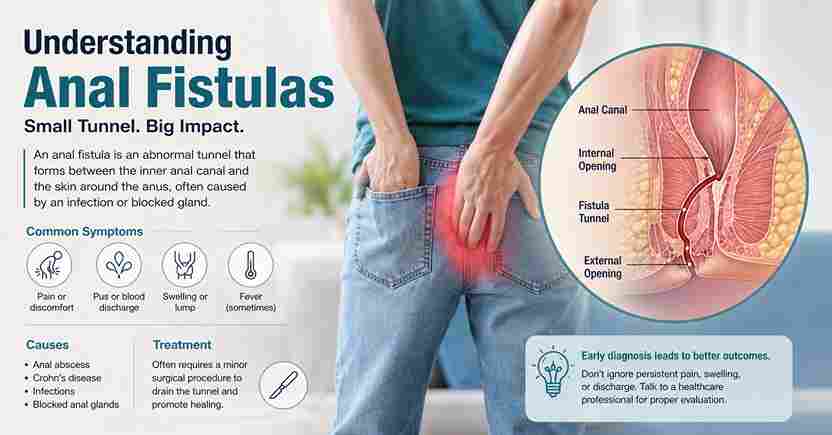
Understanding Anal Fistulas
An anal fistula is an abnormal tunnel that links the anal canal to the skin around your anus. It usually starts after an infection or abscess that did not heal well, so a small tract stays open and keeps draining. Anal fistulas often cause ongoing pain, discharge, and can interfere with daily tasks like walking, sitting, or using the toilet.
Doctors sort fistulas into “simple” and “complex.” A simple fistula has a short, single tract that passes through a small part of the sphincter muscles. A complex fistula may have multiple branches, pass through a large part of the sphincter, or involve nearby areas, such as a rectovaginal fistula between the rectum and vagina or pouch-anal fistulas in people with previous bowel surgery or Crohn’s disease.
Complex fistulas are harder to treat and often need staged procedures, like a seton or a LIFT procedure, to protect continence. Early recognition matters because long-standing tracts can lead to chronic infection, scarring of the anal sphincter, and in severe cases, trouble controlling gas or stool.
Anal fistulas are most common in adults around age 40, but you can be younger, especially if you have Crohn’s disease or another inflammatory bowel disease. Common associated conditions include:
- History of a drained anal abscess
- Crohn’s disease or ulcerative colitis
- Prior anorectal surgery or obstetric injury
- Past surgery or radiation for anal cancer
- Ongoing infections in the anal region
The Symptoms
Anal fistulas usually cause deep, nagging pain around your anus that often gets worse when you sit, cough, or have a bowel movement. You may notice a small lump or swelling next to the anus, with clear, yellow, or blood-stained discharge on your underwear or toilet paper. This discharge can ease the pain for a while because it releases pressure from a trapped pocket of pus.
You may notice a small external pit or opening on the skin, occasionally with a crust or discoloration from dried discharge. Other times, patients present with what appears to be recurring abscesses that just come and go in the same location. The region can become sore, itchy, and moist, and passing stools can initiate burning or sharp pain, even when the stool is loose.
Additional symptoms can be light bleeding, skin irritation, or rash due to constant moisture. When the infection is active, the skin often appears red and warm and you may experience fever, chills, or malaise. Foul-smelling pus is a red flag for ongoing infection and generally requires urgent medical attention.
The Causes
Most anal fistulas start from a blocked anal gland inside the anal canal. Bacteria grow inside the blocked gland, an abscess forms, and then that abscess tries to drain to the skin surface, leaving a tunnel behind. Even if the abscess is drained once, the tract can stay. This is why people with a history of a drained anal abscess have a higher risk of later fistula.
Inflammatory bowel diseases, especially Crohn’s disease, play a big role too. In Crohn’s, chronic inflammation can weaken the bowel wall and create multiple or branching fistulas, including rectovaginal and pouch-related fistulas that are harder to fix and may need stepwise treatment with setons and later procedures like LIFT.
Trauma to the anal area, such as tears during childbirth, previous anorectal surgery, or direct injury, can damage tissue and open a path for infection. Surgery or radiation therapy for anal cancer can change blood flow and healing in the area and raise your long-term risk.Rare causes include:
- Tuberculosis or other specific infections
- Sexually transmitted infections affecting the anal region
- Foreign bodies or penetrating injuries
- Tumors in the anal canal or rectum
The Complications
If an anal fistula is not treated, the most common problems are repeated abscesses, chronic drainage, and skin breakdown. The constant cycle of swelling, pus, and discharge can make daily life hard, from sitting at work to long travel or exercise. The ongoing infection can spread, forming new branches and turning a once simple tract into a complex one.
Damage to the anal sphincter is another key concern. The fistula itself may pass through important muscle fibers, and some treatments can risk further injury if not planned carefully. This is why surgeons may place a seton first, which is a loop of surgical thread left in the tract for several weeks to keep it open, slowly widen the tunnel, and let infection drain.
A cutting seton can be tied in a circle and tightened over time, while a loose seton is often used as a safer long-term drain in people with Crohn’s disease. Even when well cared for, certain wounds are slow to heal. You could have a never-healing open wound that requires daily irrigation, sitz baths, and dressings.
To reduce the chance of incontinence, numerous complicated fistulas are handled with staged procedures. For instance, a LIFT procedure is typically performed once everything has settled down, or the surgeon might take out just the infected tissue and close the internal opening a few weeks after the initial infection has been tamed.
They can recur, particularly in Crohn’s disease, smokers, or anyone who has active rectal inflammation. Over time, new tracts can form, twist, or branch. Mapping with imaging and careful surgical planning are key if you want both stable healing and good control of bowel function.
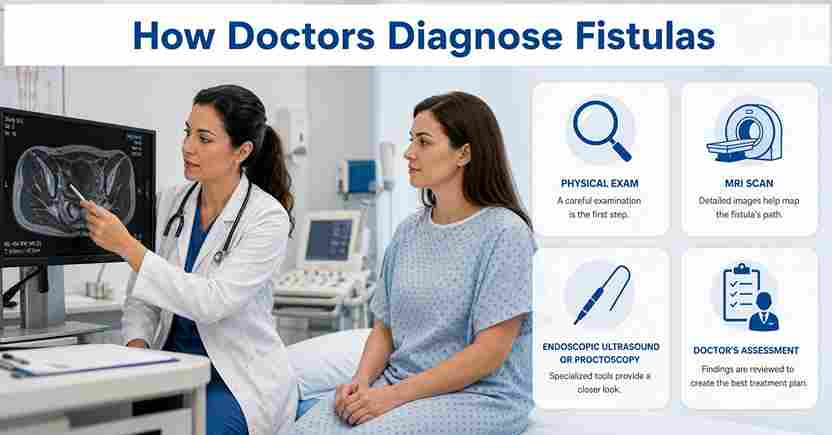
How Doctors Diagnose Fistulas
You make your way step by step so your doctor can observe where the fistula originates, where it travels and what it impinges on along the journey. That complete mapping directs a safe course of treatment and reduces your chances of suffering incontinence.
Diagnosis starts with your medical history and a careful look at symptoms. Your doctor asks about pain, swelling, drainage, prior abscesses, surgery, Crohn’s disease, trauma, or infections such as tuberculosis. They note how long you have had symptoms and if they flare or stay steady. This helps sort out the cause, the likely path of the tract, and how much of your anal sphincter might be involved.
Next is the physical exam and digital rectal exam (DRE). Your doctor checks the skin around your anus for external openings, scars, or small pits that may drain pus or clear fluid. They gently press around the area to feel for cords, hard spots, or hidden abscesses.
With a gloved, lubricated finger in your rectum, they assess the tone and integrity of your external anal sphincter and try to feel the internal opening. In real life, no external opening may be seen, and a strong anorectal spasm on DRE can make the exam hard and painful. This step is often slow and cautious.
When the tract is not clear from the exam alone, imaging comes in. Endoanal ultrasound uses a small probe in the anal canal to show the fistula and internal opening. Some studies report good accuracy for this, especially in simpler tracts.
Magnetic resonance imaging (MRI) is the key tool for complex fistulas. It can reach up to 100 percent accuracy in finding the internal opening, primary and secondary tracts, abscesses, horseshoe tracts, and how all of this sits in relation to your anal sphincter. MRI uses specific sequences such as T2 spectral attenuated inversion recovery, short tau inversion recovery, turbo spin echo, and fast field echo, taken in coronal, sagittal, and axial planes to build a full three-dimensional picture.
Older tests like fistulography, where contrast dye is injected into the tract and then X-rayed, are used far less now but may still appear in some centers. To see the anal canal and rectum from the inside, your doctor may use anoscopy or proctoscopy. A short scope gives a direct view of the mucosa and helps find an internal opening that might be too small to feel on digital rectal examination.
In practice, even with a good exam and imaging, a clear internal opening is found in only about one third of patients, so your team often combines all findings before making a call. The third and final crucial step is characterizing the fistula. Your doctor considers how high the tract runs, how it relates to the sphincter muscles, how many openings you have, and if you have side branches or abscesses.
On MRI, standardized classification systems and reporting guidelines exist, which radiologists follow so surgeons have a common, clear language. Your doctor keeps rare causes in mind: for example, they might send pus for polymerase chain reaction testing, which is more sensitive than standard histopathology for picking up tuberculosis, a rare but important cause.
Having this complete picture up front is what enables your team to select from the options — fistulotomy, setons, advancement flaps, or newer sphincter-sparing methods — with precision rather than guesswork.
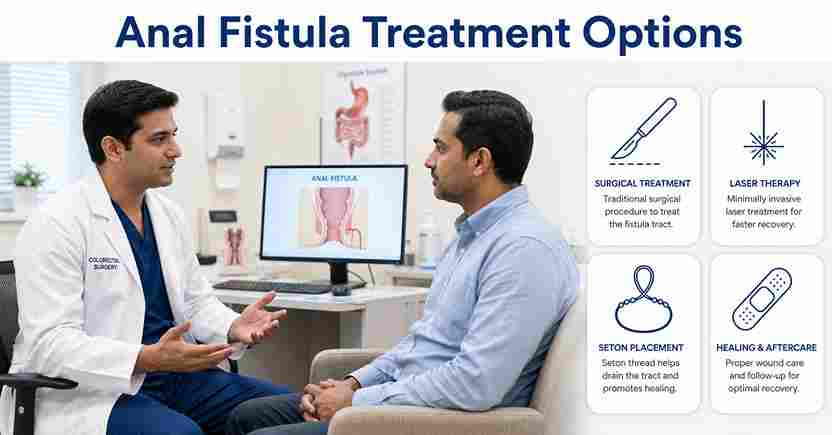
Your Anal Fistula Treatment Options
Your treatments range from traditional surgery to newer laser and biologic options. The best combination depends on the complexity of your fistula, how much sphincter muscle is involved,and whether you have other conditions like Crohn disease.
| Option | What it is / key use | Pros | Cons / limits |
| Fistulotomy | Cut tract open, heal from bottom up | Simple, well‑studied, 50–90% success | Wound care, slower healing, risk of incontinence if muscle divided |
| Seton (cutting or loose) | Surgical thread left in tract for weeks | Protects sphincter, controls infection | Needs follow‑up; may need second surgery |
| LIFT | Ligation of intersphincteric fistula tract, sphincter‑sparing | Good healing, low continence risk | Needs skilled surgeon, not ideal for every tract pattern |
| Advancement flap / flap + seton | Tissue flap covers internal opening in complex cases | Useful for high or recurrent fistulas | Technically demanding, flap failure or recurrence possible |
| Biologic drugs ± surgery | Target inflammation in Crohn or stubborn fistulas | Helps close complex tracts, reduces drainage | Costly, infection risk, needs ongoing monitoring |
| Laser (FiLaC, EFLA) | Radial laser fiber ablates tract from inside | Minimally invasive, preserves sphincter, less pain | Variable access and cost, long‑term data still growing |
| Stem‑cell–assisted approaches | Cells injected around tract to aid closure (research stage) | Hope for tough recurrent cases | Not yet standard, availability and cost are major issues |
Some cases need a staged plan. For example, a loose seton first keeps the tract open and drains infection. Then, a fistulotomy, flap, or laser can be done once things are quiet. Success hinges on your general health, smoking status, and very simply, how experienced your surgeon is with complex anal fistula work.
1. Fistulotomy
Fistulotomy remains the mainstay for simple, low fistulas. Your surgeon unroofs the entire tract from the internal to external opening, flattens it, then allows it to heal from the bottom up. This is known as healing by secondary intention. You leave with an open trough instead of a tunnel, reducing the risk of secreted pus or a new abscess.
This option is most suitable for superficial and intersphincteric fistulas that traverse minimal or no sphincter muscle. Among that cohort, healing rates typically hover in the 50 to 90 percent range, particularly if there’s no active infection and the internal opening is patent. The trade-off is a longer wound healing time requiring daily cleaning and dressing changes for several weeks or longer if you have diabetes, smoke, or are a professional sitter.
The chief hazard is sphincter injury. If the tract cuts through a lot of muscle and is still laid open, then you may be subject to gas leakage or less frequently stool incontinence. This is why fistulotomy is typically avoided in high transsphincteric, suprasphincteric or horseshoe fistulas and why many surgeons combine a fistulotomy with a seton or flap just when they’re confident the muscle burden is sufficiently low.
2. Seton Placement
Seton is a strip of surgical thread your surgeon shoves through the tract and ties into a loop, then leaves in place for weeks or even months. It keeps the fistula open, allows steady drainage, and helps the wound heal from the bottom instead of trapping pus. This is particularly helpful in high or branching tracts where a single cut would sacrifice too much sphincter.
They come in two general styles. A loose seton is essentially a drain and stabilizer that minimizes pain and risk of abscess and delays the need for a significant intervention. A cutting seton is tied tighter or tightened over visits so that it slowly slices through tissue while scarring behind it, attempting to close down the tract as it progresses. They protect continence.
Many surgeons now prefer loose setons followed by a second-stage procedure such as LIFT, flap, fistulotomy of the low remnant, or laser. Setons reduce your risk of sphincter injury compared to performing a big fistulotomy up front in a complex fistula. They complement biologics in Crohn disease, where inflammation is elevated and early aggressive surgery would be dangerous.
You still require regular flushing and cleaning. Having a seton loop in that region might feel odd or bothersome initially.
3. LIFT Procedure
The LIFT procedure (ligation of the intersphincteric fistula tract) is a sphincter-sparing surgery for transsphincteric fistulas, where the tract goes through the internal and external sphincter. LIFT attempts to close the tract exactly where it passes through the muscle, preserving the muscle rings to a large extent. This is particularly important if you’re younger, have a high-pressure occupation, or already experience minor continence problems.
For LIFT, your surgeon makes a small incision in the sulcus between the internal and external sphincter, which is the intersphincteric space. They locate the fistula tract, tie it off near the internal opening, occasionally in two locations, slice and remove that section of tunnel, and seal up the muscle and skin over it. The external portion of the tract can be curetted or allowed to drain through a small incision.
LIFT’s healing rates in many series are excellent, and its risk of incontinence is much less than wide fistulotomy into comparable transsphincteric tracts. Yes, there are failures, generally when the internal opening can’t be identified or the tissue is excessively scarred from previous surgery. In a few centers, LIFT is preceded by prior seton drainage to quell infection and facilitate easier tract identification.
4. Biologic Agents
If you have perianal Crohn disease or a fistula that keeps coming back despite surgery, biologic drugs come into play. These medicines target the inflammatory pathways that drive Crohn disease and chronic fistula activity, rather than simply cutting the tract out again. When the inflammation quiets down, the tissue around the anus has a better chance to seal off and stay closed.
More commonly, your physician will recommend anti-TNF agents like infliximab or adalimumab, administered by infusion or injection on a set schedule. They work by blocking tumor necrosis factor-alpha, an important immune messenger. Other biologics that act on different steps of the immune system may be prescribed if these fail or result in side effects.
On their own, biologics rarely solve a large, established anal fistula. The best results usually come from a mix of loose setons or drainage to keep pus away, followed by biologic therapy to calm disease and help closure, sometimes followed by a targeted procedure like LIFT, flap, or laser for any remaining tract. This blended path is common in major inflammatory bowel disease centers.
Biologics have downsides. They are expensive, can raise infection risk, and mean long-term monitoring with blood tests and imaging. After all, for a lot of Crohn-associated fistulas, they can be what ends up tipping things toward sustained healing rather than recurring abscesses and surgeries.
5. Anal Fistula Laser Treatment
Anal fistula laser treatment, such as FiLaC (fistula‑tract laser closure) or EFLA (endofistula laser ablation), offers a minimally invasive, sphincter‑saving option. Your surgeon passes a thin radial laser fiber through the tract, usually after gentle curettage and treating or closing the internal opening.
They then pull the fiber back slowly while the laser energy shrinks and seals the tract from the inside, starting at the inner end and moving outward without cutting much or any sphincter muscle. The big attractions here are smaller wounds, less post op pain and less day-to-day wound care than a wide open fistulotomy or a big flap.
Most patients are ambulatory within days and time away from work may be reduced. Because the sphincter is preserved, the risk of new incontinence is low, which is important if the fistula crosses a lot of muscle or if you’ve had prior surgery. Healing and recurrence rates for laser techniques are promising and mixed across studies.
They are often comparable or a bit better than some traditional options when surgeons are experienced and cases are well selected. In more complex branching tracts or with very active Crohn disease, success can dip. Some individuals still require a second laser session or alternative surgery.
Surgeons can utilize a laser following a period with a loose seton to reduce infection and outline the tract. Availability and price are actual constraints. Not every hospital has the laser system and not all insurance plans or national health systems reimburse for it yet.
Talk with your surgeon about their experience with how many of these procedures they’ve done, your fistula map on imaging, and how laser compares with LIFT, advancement flap, or a staged plan in your specific case. Stem cell-assisted closure of the tract, occasionally combined with surgery, is another emerging area, but for now it remains in specialized centers and research environments, primarily for difficult recurrent cases.
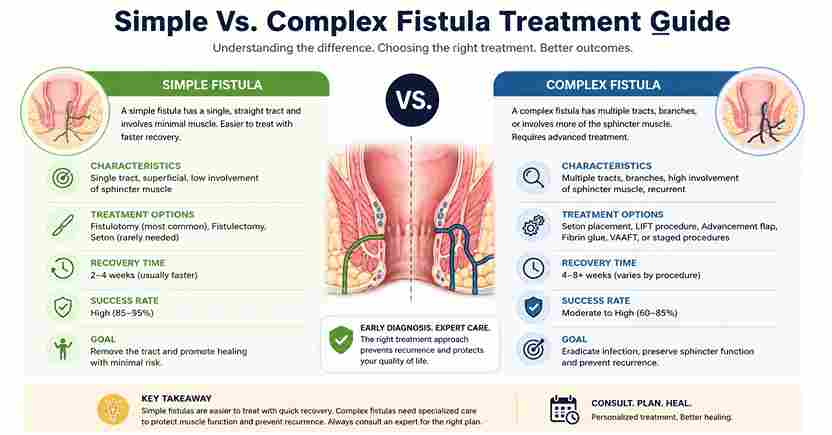
Simple Vs. Complex Fistula Treatment
You first need to know if your anal fistula is “simple” or “complex” because that choice shapes almost every treatment step and your risk of side effects.
A simple fistula is usually a single, short tract, often less than 3 cm, with a clear internal and external opening, and it passes through little or none of the anal sphincter muscle. In many people, it sits low, close to the skin, without branches. These often respond well to one operation. In fact, short fistulas under 3 cm have shown healing rates around 58 percent, compared with only 16 percent for longer ones.
A complex fistula is different. It may have multiple tracts, a “horseshoe” shape wrapping around the anus, a blind sinus that ends in a dead-end pocket, or it may cross more than about 30% of the sphincter muscle. Recurrent fistulas, Crohn’s disease-related fistulas, and long-standing tracts fall into this group. About 20% of people with anal fistula end up in this complex category, and these often need a specialist team and staged care.
Left untreated for years, some complex fistulas can even turn into cancer inside the tract, which is why steady follow-up is so important.
Simple fistulas often do well with a fistulotomy, where the surgeon lays open the tract so it can heal from the base outward. For genuine simple, low tracts, this can be effective and safe as well. Performing the same ‘simple’ fistulotomy on a complex, high fistula can sever too much muscle, resulting in incontinence in 2 to 63 percent of individuals. Hence the need for meticulous tract and muscle mapping.
For complex diseases, your plan is more customized. Surgeons might use setons to hold the tract open and drain infection, sphincter-sparing procedures such as advancement flaps or LIFT, which has approximately 76% success. However, this success rate is less so in horseshoe, Crohn’s, or recurrent cases, or newer minimally invasive approaches.
Among various methods, one big review of 4,883 patients found around 93% overall healing. However, around 12.7% had some baseline continence change, which you should factor into your decisions.
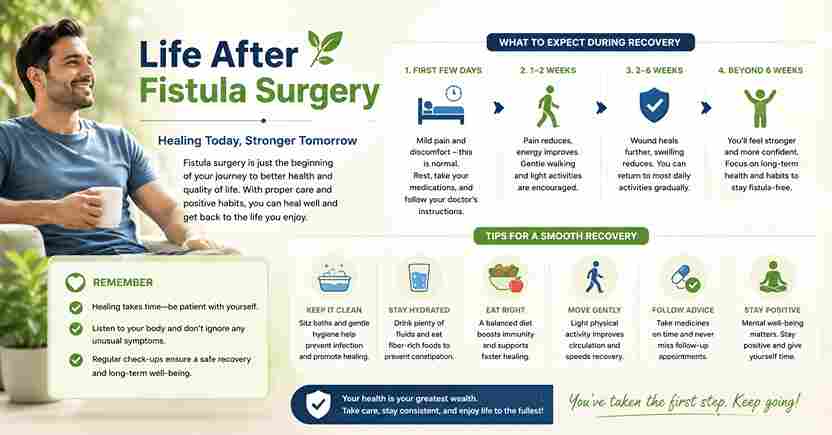
Life After Fistula Surgery
Life after fistula surgery focuses on consistent healing, intelligent self-care, and being mindful of your body so you can catch issues early and return to daily life with less anxiety.
Recovery Path
For a simple anal fistula, the wound often closes in about 4 to 6 weeks if you care for it well. Deeper or multiple tracts can take longer, so you may see gradual changes rather than quick results. The area can feel quite sore for the first couple of days, and it is normal to have some discomfort and a little bleeding with the first bowel movements after surgery, especially if the wound sits close to the anal opening.
You generally go home the same day. You should plan to take it easy for the remainder of the day and have someone drive you home and stay with you for 24 hours, as you may still be under the influence of anesthesia or potent pain medication.
Pain control is important for both comfort and recovery. Lots of folk use prescribed painkillers 15 to 20 minutes before they sh*t to smooth things out. Warm sitz baths, or a warm bath in which you soak your bottom for 10 to 15 minutes, can relax spasms, wash away discharge, and assist the wound drain. You are frequently advised to soak the region in warm water at least once daily and post-defecation if feasible. Then pat dry, don’t rub.
Monitor your bowel movements, as constipation stresses healing tissue. Drinking plenty of water, increasing your fiber intake, and taking a stool softener if your doctor feels it’s appropriate can keep stools soft and easy to pass. Light walking is typically okay, but heavy lifting, hard exercise, or running should be avoided for approximately a week or longer if recommended by your surgeon. Attend all follow-up appointments, even months later, to ensure the tract has completely sealed.
Recurrence Risk
The risk of a fistula recurrence depends on the original fistula tract, the surgery, and the experience of the surgeon. Two patients with what sounds like an identical issue on paper can have very different long-term outcomes. A short, single, superficial tract heals and stays closed, whereas complex branching or high fistulas that cross more of the sphincter carry a greater recurrence risk and may require staged procedures or setons.
The technique of the surgery is a crucial factor. The more completely the tract is opened, excised, or sealed and the better any internal opening is closed, the less likely it is that residual infected tissue will cause a fresh abscess or a new fistula. Therefore, you reduce your own risk by maintaining hygiene, adhering to wound-care protocols, and contacting your physician promptly when something doesn’t feel right rather than waiting for it to pass.
Use a short mental checklist for warning signs of recurrence:
- Emergence of new or exacerbating pain after an interval of improvement.
- New swelling or a hard lump around the old fistula site.
- Pus, foul-smelling discharge, or additional bleeding from the wound or surrounding skin.
- Fever, chills, or feeling unwell with rectal pain.
- A new opening on the skin that leaks fluid.
Long-Term Outlook
With the right procedure and steady care in the first weeks, most people reach stable, long-term healing and return to regular work, travel, and exercise without constant worry about leakage or sudden abscesses. The effort you put into recovery usually pays off in daily comfort.
A small number of people, especially those with complex or high fistulas, may notice mild changes in bowel control, such as slight leakage of gas or small smears of stool. While this can feel worrying, it is often manageable with pelvic-floor exercises, diet changes, and in some cases, reviewed by a specialist who can test sphincter strength.
If your fistula was associated with an underlying chronic condition such as Crohn disease, you may still require long-term treatment to maintain gut inflammation in check. This decreases the risk of new fistulas down the road and stabilizes your baseline.
Studies that follow patients for years show that once the fistula heals and any infection is cleared, most report a clear rise in quality of life: less pain, fewer unplanned clinic visits, more confidence in social settings, and better sleep because they are not waking up from throbbing rectal pain or drainage.

The Unspoken Emotional Impact
Anal fistula is not only a physical issue. It sits in a private part of your body, so the pain, drainage, and discomfort often come with silent emotional weight that you may not share with anyone. You might plan your day around toilets, wound care, pads, or spare clothes. That constant watchfulness can slowly drain your mood, focus, and sense of ease in your own body.
You might be embarrassed by odor, leakage, or stained clothes, even though you’re doing all you can to keep clean. They begin declining social engagements, extended trips, or meetings that run an hour or more. Work can take a hit if you have to get up frequently, switch out dressings, or pretend you’re not hurting.
Over time, this can manifest as social withdrawal, even from a close friend or partner, and you may feel more isolated than you actually are. Stigma around anal disease can make you think this problem is “dirty” or shameful. In some cultures, the pressure is even stronger.
For example, if your faith or daily routine needs full body cleanliness for prayer or ritual, like many people in Saudi Arabia and other regions, the drainage and repeated cleaning can cause deep stress and guilt. You might worry about being “pure enough” even when you follow medical advice.
Because the condition is chronic and can need repeated care or surgery, anxiety and low mood are common. You may fear smells in a quiet room, stains during travel, or pain during sex. To cope, it helps to treat the emotional side as part of your care plan: speak honestly with your doctor, ask for a referral to a counselor if you feel stuck, and look for peer groups online or in person where others live with anal fistula or other chronic anal disease.
Simple steps like setting a clear hygiene routine, planning soft cushions or breaks at work, and agreeing on a discreet check-in word with a partner can lower daily stress and give you back some control.
Conclusion
Anal fistula takes a real toll on your body and your head. You deal with pain, leaks, smell, fear of plans and worry about the next flare. None of that feels small.
You have actual options now. You know the way doctors check a fistula. You know the big ones. You know that life post surgery is weird for a bit, then more liberated as time goes on.
You don’t have to ‘suffer in silence.’ A frank conversation with a colon and rectal surgeon can transform your next 12 months, not just your next 12 days. If your gut says it’s time, schedule that appointment, bring your questions, and give yourself a fighting chance for relief.
Frequently Asked Questions
What is an anal fistula, and is it dangerous?
An anal fistula is a small tunnel between the anal canal and the skin near your anus. It often starts from an infection or abscess. It is usually not life-threatening, but it does not heal on its own and needs medical treatment.
How do doctors diagnose an anal fistula?
Your doctor will first ask about your symptoms. Then they examine the area around your anus. They may use tools like an anoscopy, ultrasound, or MRI to see the fistula’s path. This helps plan the safest and most effective treatment for you.
Can an anal fistula heal without surgery?
In most cases, no. Anal fistulas rarely close by themselves. Creams, antibiotics, or home remedies may ease pain, but they do not remove the fistula. Surgery or a minimally invasive procedure is usually needed to prevent ongoing infection and repeat abscesses.
What are the main treatment options for an anal fistula?
Your choices are fistulotomy, seton placement, advancement flap, LIFT, and laser or video-assisted approaches. Your surgeon selects according to fistula depth, location, and your continence risk. The objective is to treat the fistula and preserve your sphincters.
What is the difference between a simple and a complex anal fistula?
A simple fistula is a short, single tract that passes through a minimal portion of the sphincter. It is generally simpler to cure. A complex fistula is deeper, has multiple tracts, or involves more sphincter muscle. It requires more sophisticated approaches to safeguard continence.
How long does recovery take after anal fistula surgery?
The vast majority resume gentle daily activity within a few days. Wound healing can take four to eight weeks to completely heal depending on the procedure performed and fistula complexity. Good hygiene, a high-fiber diet, and follow-ups with your surgeon help you heal faster and safer.
Is it normal to feel embarrassed or anxious about having an anal fistula?
Yes. Anal fistulas affect a very private area, so embarrassment and anxiety are common. You are not alone. Talking openly with your doctor and, if needed, a counselor can help. Modern treatments are effective, and seeking help is a strong, positive step.