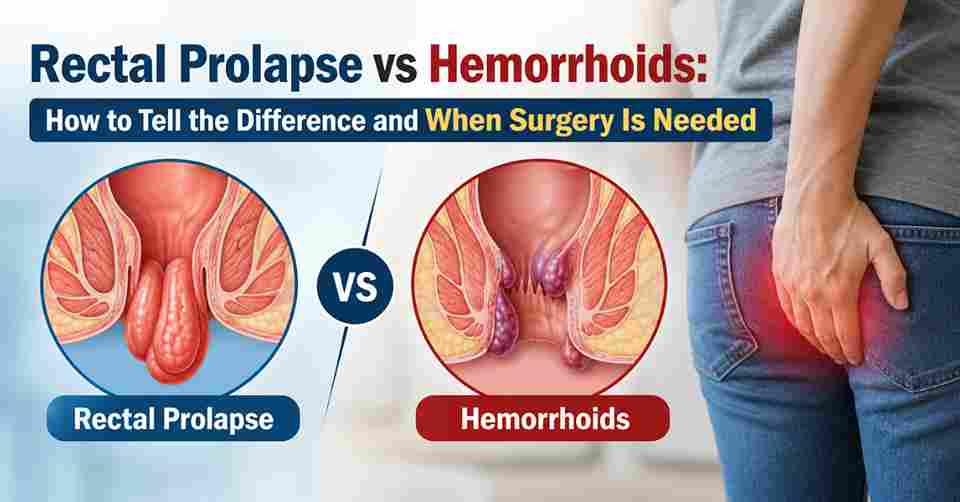
Rectal prolapse vs hemorrhoids is a common search when you notice something wrong around your anus and feel unsure what it means. You might see a lump, feel pain, or spot blood on toilet paper and wonder what counts as an emergency.
You want to know what is treatable at home and what needs a doctor. In the next sections, you walk through clear signs, causes, and treatment paths.
Key Takeaways About Hemorrhoids And Rectal Prolapse Their Diagnosis And Treatment
- You deal with two different problems when you compare rectal prolapse and hemorrhoids. Both can cause a bulge, bleeding, and discomfort. Rectal prolapse involves the rectal wall slipping out through the anus, while hemorrhoids are swollen blood vessels in or around the anal canal.
- You can often tell them apart by how they look and feel. Rectal prolapse usually appears as a circular, moist tube of tissue with folds all the way around, while hemorrhoids are separate soft lumps or nodes at or just inside the anal opening.
- You might observe some different symptom patterns between the two. Rectal prolapse is associated with mucus discharge, fecal leakage and weaker sphincter tone, whereas hemorrhoids tend to cause sharp pain, particularly in the case of external or thrombosed hemorrhoids.
- You need to notice bleeding and incontinence. Frequent bright red bleeding and difficulty holding stool or gas indicates rectal prolapse, while briefer bleeding episodes with bowel movements and preserved control favors hemorrhoids.
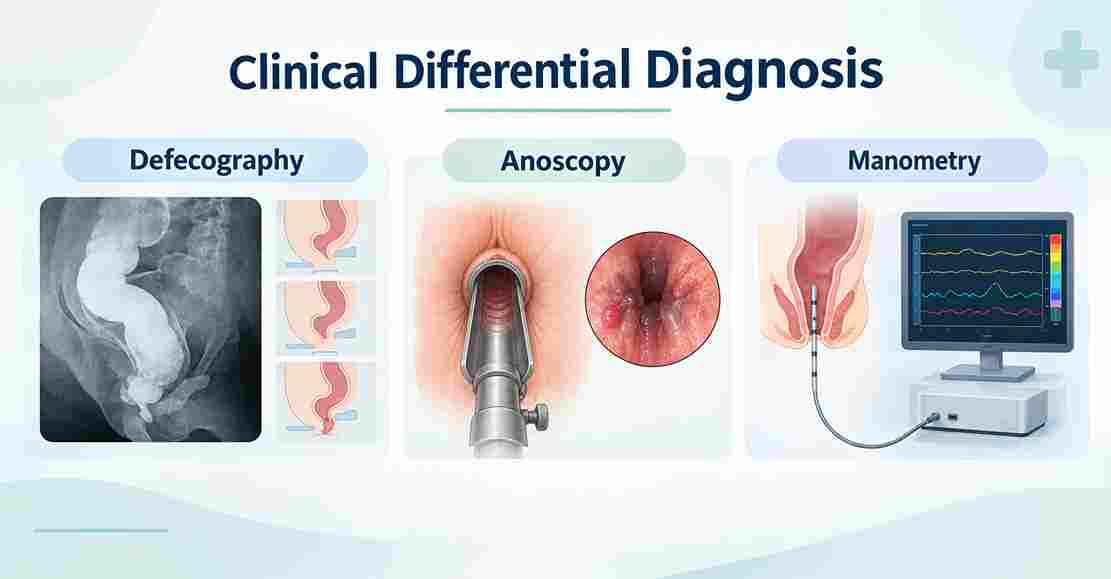
- You need to see a doctor, not diagnose yourself. Tests like defecography, anoscopy, and anorectal manometry let your healthcare provider see how your rectum moves, how your sphincter works, and if the bulge is a prolapse or hemorrhoids.
- You have treatments from lifestyle changes to surgery, depending on the cause and severity. You can usually manage symptoms with fiber, hydration, pelvic floor exercises, and outpatient procedures. Advanced rectal prolapse or severe hemorrhoids might require specialized surgical repair for long-term relief.
Rectal Prolapse Vs Hemorrhoids Basics Treatment Options
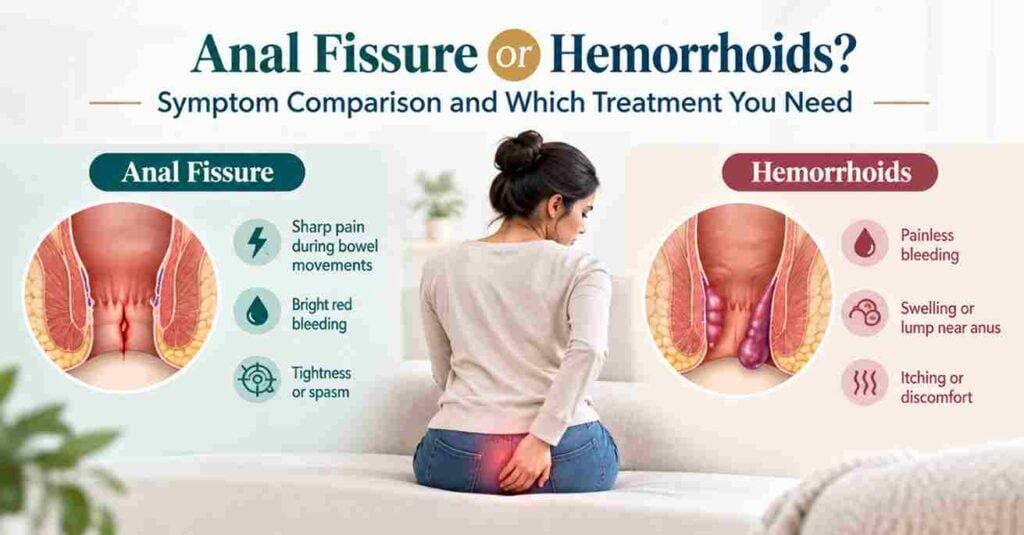
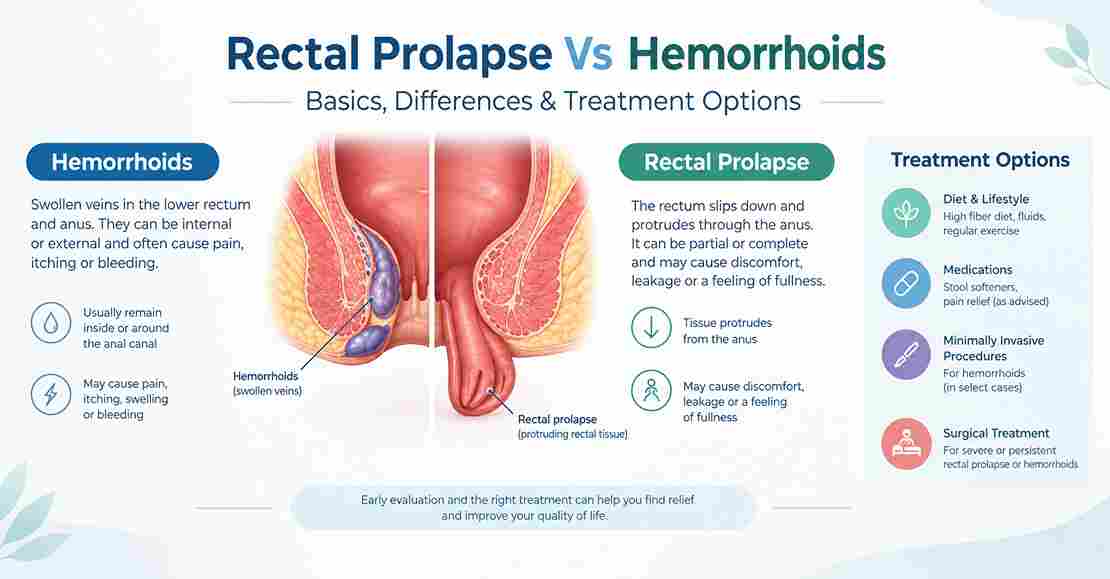
You deal with two very different problems here, even if they sit in the same area and share symptoms. Rectal prolapse means part or all of your rectal wall slides down and comes out through the anal opening. Hemorrhoids are swollen veins in the anal canal or lower rectum that may or may not stick out.
In rectal prolapse, the rectal wall and its supports are the issue. In hemorrhoids, the issue is blood vessels and the surrounding soft tissue. Both can cause bleeding, pain, mucus, and a bulge, which is why people confuse them, but the treatments and long-term risks aren’t the same.
You can sort them out by a few key points:
- Location: Prolapse comes from higher in the rectum and passes through the anus. Hemorrhoids sit at the anal canal or verge.
- Tissue involved: Prolapse affects the full rectal wall. Hemorrhoids are venous cushions and mucosa.
- Look: Prolapse is a smooth, tube-like ring of tissue. Hemorrhoids are distinct lumps or nodes.
Age is a factor in both. As muscles and ligaments become weak with age, the susceptibility for rectal prolapse and hemorrhoids increases. Hemorrhoids are most likely to strike between 45 and 65 years, whereas rectal prolapse can occur in very young children, particularly those under the age of two, when a small portion of the rectum may protrude during defecation.
Since the symptoms can be similar, you usually require a thorough examination. A clinician will examine your history and inspect the area while you strain. They may then use a proctoscope, anoscope, or sigmoidoscopy to peer inside and confirm which of the two you have.
Mild cases of either can subside with more fiber, good hydration, and less straining. More severe prolapse or advanced hemorrhoids may require office procedures or surgery. This is exactly why nailing the diagnosis really informs what happens next for you.
Rectal Prolapse Symptoms Vs Hemorrhoids
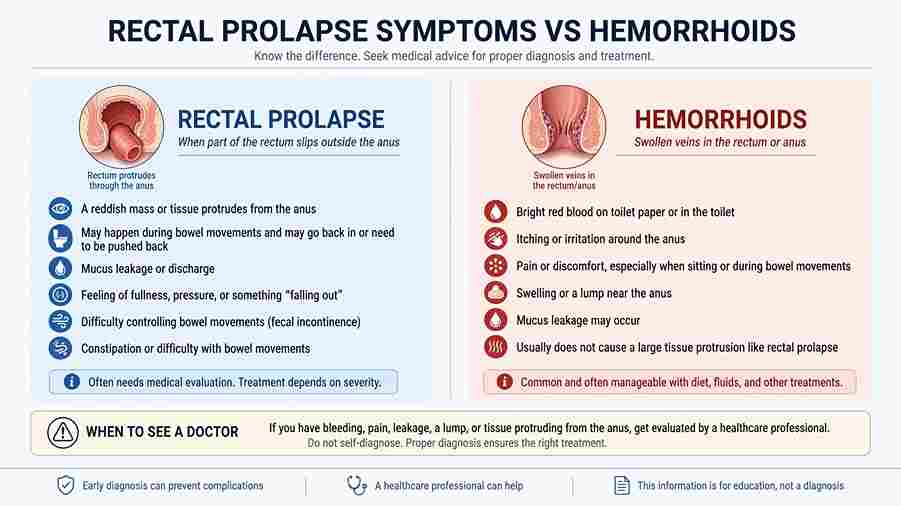
Both conditions affect your rectum and anus and can share bleeding, bulging, and discomfort. They behave differently. Hemorrhoids are swollen veins in the anal canal. Rectal prolapse happens when part or all of the rectum slides out of place and may protrude through the anus. Symptom patterns, severity, and how often they appear help you and your doctor sort them out and choose the right treatment.
| Symptom / Feature | Rectal Prolapse | Hemorrhoids |
| Main problem | Rectum slips out of normal position | Swollen anal veins |
| Bulge pattern | Circular, moist tissue; often after strain | Localized lumps or cushions; may be single or several |
| Pain | Often mild or none; more if ulcerated/infected | Can be severe, especially external or thrombosed |
| Bleeding | Bright red, may ooze from exposed mucosa/ulcers | Often streaks or drops on stool or paper |
| Mucus discharge | Common, larger volume, persistent | Mild, usually with internal hemorrhoids |
| Itching/irritation | From mucus and skin breakdown | Very common from swelling, leakage, wiping |
| Sphincter tone | Often reduced; linked to pelvic floor weakness | Usually normal |
| Incontinence | Frequent; urge and passive leakage | Rare, usually only in advanced prolapse with hemorrhoids |
| Triggers | Chronic constipation, pelvic floor weakness | Straining, pregnancy, heavy lifting, prolonged sitting |
| Prevalence | Rare (~0.5%); more in adults ≥50, mostly women | Very common worldwide |
Rectal prolapse symptoms often include a bulge after coughing, sneezing, or lifting, a sense of pressure, mucus in stool, and fecal incontinence. Hemorrhoids more often show up as pain and irritation around the anus, itch, a hard lump, and blood in stool. Severity can vary by type and grade of prolapse or hemorrhoid, and tests like defecography and a full anorectal exam are key to tell them apart and to spot issues like pelvic floor problems.
Chronic constipation is especially common with prolapse, and recurrence can reach about 26 to 30 percent, so ongoing care and follow-up matter.
1. Pain Thresholds
With rectal prolapse, you can have a vivid bulge and yet experience very little pain. Many complain of more of a dragging or pressure in their rectum, which intensifies when they stand for a long time, strain, or walk a lot, and then subsides when they lie down or gently reduce the tissue. Pain may increase if the exposed lining dries and becomes ulcerated or infected, as the mucosa is not designed to be exposed to air, friction, or wiping.
This raw tissue may then bleed and burn with defecation, cleaning, or even normal activity. Hemorrhoids can be quite painful, especially external ones or when a clot forms, which is a thrombosed hemorrhoid. That pain is often sharp, sudden, and focused at one spot at the anal edge. You may feel a tender, hard lump that hurts to sit on or touch.
Internal hemorrhoids tend to hurt less but can still cause a deep ache or cramp if they swell or become strangulated. In simple terms, prolapse is more often a dull, heavy discomfort, while hemorrhoids, when inflamed, are more likely to cause sharp, acute pain that makes basic tasks like sitting or passing stool feel hard.

2. Bleeding Characteristics
Rectal prolapse tends to cause light bleeding, bright red, from the exposed rectal mucosa or from small superficial ulcers. You may notice this as staining on tissue, streaks on the stool, or light oozing from the prolapsed tissue itself that lingers for a period after a bowel movement, particularly if it remains prolapsed outside.
That slow oozing can be simple to overlook; however, in time it could cause anemia if the blood loss accumulates and goes unchecked. With hemorrhoids, bleeding is usually associated quite directly with bowel movements. You might observe bright red blood on the toilet paper, on the stool’s surface, or as drips in the toilet, but not much in between bathroom visits.
Internal hemorrhoids in particular can bleed without causing pain, which occasionally postpones care because the bleeding seems light or normal to you. Rectal prolapse bleeds more constant low-grade blood or staining, whereas hemorrhoids are more intermittent and associated with strain, hard stool, or flare-up episodes.
Any heavier flow, clots, or recurrent bleeding deserves timely medical evaluation, as both can have complications and other causes such as polyps or tumors need to be excluded.
3. Sphincter Tone
In rectal prolapse, the anal sphincter muscles often lose strength and tightness, and the pelvic floor can weaken too. This loss of tone makes it harder for you to hold back gas, mucus, or stool, especially soft stool. You might notice streaks in your underwear, trouble holding it when you feel the urge, or leakage after you think you have finished a bowel movement.
With hemorrhoids alone, sphincter tone generally remains normal. You may feel a sense of fullness or that something is present, but the ring muscle still functions unless you have prolapse too or prolonged straining that has lengthened the supporting structures. Therefore, your risk of true incontinence with straightforward hemorrhoids is minimal.
You can experience leakage related to mucus or hygiene. The effect on continence is one of the major clinical distinctions. Rectal prolapse is far more likely to cause urge incontinence (can’t hold it, no time) and passive incontinence (leaking without realizing it), potentially devastating work, social life and travel.
This is one of the reasons why your care team might discuss pelvic floor work, surgery, or both if prolapse is found, even if your pain is not significant.
4. Mucus Discharge
Rectal prolapse tends to involve a significant amount of mucus discharge, as the inner rectal lining is now exposed. That lining produces mucus naturally to help stool pass, but once it’s outside, the mucus can seep onto your skin or underwear, even when you’re not on the toilet.
It can be stringy, clear, or just a bit yellow, and you may feel perpetually wet or need to wear pads. Many people find this very annoying and humiliating. Hemorrhoids, particularly those that are internal, can ooze mucous but generally less abundantly. You may experience minor staining of tissue, a film on stool or slight dampness after a bowel movement.
The amount is usually much less than with prolapse and can only present itself during flares, not daily. Over time, ongoing mucus in either condition can irritate the skin around your anus. The area can turn red, itchy, and sore, and you may see small cracks or raw patches.
This skin breakdown makes cleaning harder and can raise the risk of minor infections or fungal overgrowth. Gentle hygiene, barrier creams, and addressing the root cause of the discharge are important to protect the skin and keep symptoms from feeding into a cycle of more irritation.
5. Incontinence Frequency
Fecal incontinence occurs much more frequently and severely in rectal prolapse than in hemorrhoids. Since your rectum is displaced and your sphincter and pelvic floor are weaker, you might leak gas, mucus, or stool with minimal notice. Certain individuals sense immediate necessity and cannot make it to a toilet quickly enough.
Some have passive leakage where stool or staining comes out without any obvious urge. Day to day, these patterns can shift and they tend to worsen with chronic constipation, extended straining, or progressive prolapse grade. Hemorrhoids alone don’t usually cause true incontinence. Leakage, when it occurs, is more likely caused by mucus, residual stool after wiping, or pain avoidance that keeps you from fully emptying.
Only in extreme cases with giant prolapsing hemorrhoids and attenuated supportive tissue do you get continence issues that resemble those of rectal prolapse. The quality-of-life impact from incontinence is large. It can shape what you wear, where you go, and how confident you feel at work, in relationships, or in public spaces.
A good evaluation usually includes questions about frequency of leakage, stool consistency, and bathroom habits, along with tests like defecography that can show how your pelvic floor behaves. Targeted plans may mix diet changes, constipation management, pelvic floor therapy, and sometimes surgery, especially since rectal prolapse has a recurrence risk that can reach about 26 to 30 percent and is linked with chronic constipation in roughly 30 to 67 percent of patients.
While rectal prolapse is relatively rare, around 0.5 percent of people, more in adults over 50 and more in women, with younger men under 40 sometimes affected, its impact can be out of proportion to how often it occurs, so taking symptoms seriously is key.
Distinct Mechanical Causes
You’re addressing two completely separate mechanical issues when you contrast rectal prolapse and hemorrhoids, despite their proximity and the fact that both can lead to bleeding or a lump.
Rectal prolapse starts when the support system for your rectum gives way. The pelvic floor muscles, ligaments, and connective tissue that should hold the rectum in place get weak or stretched. This can come from years of chronic constipation and straining, past rectal or pelvic surgery, or nerve problems such as Parkinson’s disease that change how your muscles fire.
In some people, the rectal wall itself is thin or loose, or it folds in on itself inside the body first, which is known as rectal intussusception, before it later slips out through the anus. Over time, each hard bowel movement you push through adds more downward force. Aging makes this worse because tissue strength falls and healing slows.
People over 40 see a higher risk, especially if they have a long history of constipation or childbirth that stresses the pelvic floor.
Hemorrhoids come from pressure inside the veins rather than failure of the whole support system. Veins in and around the anus swell when blood flow in that area backs up. This often happens when you strain on the toilet, sit for long periods, lift heavy loads, or live with obesity that adds constant pressure in your abdomen.
A low-fiber diet and low fluid intake leave your stool dry and hard, so you push more and longer, which pushes those veins out. Pregnancy does something similar: the growing uterus and hormonal changes raise venous pressure. Aging and weaker anal muscles can let hemorrhoidal tissue bulge more easily.
Clinical Differential Diagnosis
You need a clear clinical plan because rectal prolapse and hemorrhoids often overlap in symptoms like bleeding, mucus, and a “lump” at the anus. Careful history and a full anorectal exam come first: you look at onset, pain, constipation, straining, prior pelvic surgery, and any bowel control issues.
On inspection and digital exam, you check whether the entire rectal wall protrudes in concentric folds, which is more common in rectal prolapse, or if you see discrete, often painful, hemorrhoidal cushions. Atypical lesions that are multiple, sessile, ulcerated, indurated, or larger than 3 cm need biopsy to rule out cloacogenic polyp or anal intraepithelial neoplasia (AIN).
If you see a large, fixed papilla during the exam under anesthesia, a frozen section biopsy is smart, especially if it is sessile, has a base larger than 1.5 cm, or measures over 3 cm. You stay alert for chronic anal fissure; when you see it with a hypertrophied anal papilla, that combination is diagnostic in more than 90% of cases and can easily be mistaken for hemorrhoids.
Acute thrombosed hemorrhoids alone account for 10% to 15% of emergency proctology visits, often in people in their 40s and 50s, so timing and pain level matter. Because anal lesions are common worldwide, ranging from 0.5% to 33% depending on the group, and especially frequent in people living with HIV and men who have sex with men, you cannot rely only on a quick visual guess.
AIN3 in HIV-positive patients can progress to invasive cancer in about 10% within 5 years, and the annual incidence of high-grade anal lesions in some HIV-positive men who have sex with men reaches 15% to 20%, with recurrence after treatment as high as 30% to 70%. Any anal canal adenoma also needs a colonoscopy within 3 to 6 months because up to 30% of patients have synchronous colon adenomas.
To keep all this straight in daily practice, you can build a checklist that walks you through symptom pattern, physical signs, red-flag lesion features, and when to biopsy or scope, then add targeted tests like defecography, anoscopy, and manometry. In more complex cases, you gain a lot by involving an experienced colorectal surgeon early to confirm the diagnosis and shape the treatment plan.
Defecography
You use defecography as a dynamic imaging test that shows how the rectum and pelvic floor move while you simulate defecation with contrast material in the rectum. This helps you see a full-thickness rectal prolapse that slides out through the anal canal, as opposed to a more limited mucosal prolapse or large internal hemorrhoids that bulge but do not show the same full-wall descent.
The study exposes pelvic floor issues like rectocele or internal intussusception that may sit behind long-standing constipation or a sense of incomplete emptying. Those details guide whether you plan simple perineal surgery, a more complex abdominal repair, or a combined approach if you find multiple defects.
Anoscopy
Anoscopy is your direct, close-up look at the anal canal and lower rectum with a short, lighted tube. With this, you can observe internal hemorrhoids, mucosal prolapse and the precise location of bright red bleeding, rather than having to guess based on symptoms.
You can gauge the number of hemorrhoidal columns, extent and if they conform to common grading, which then directs outpatient interventions such as rubber band ligation, infrared coagulation or sclerotherapy. You apply anoscopy to identify abnormalities inconsistent with classic hemorrhoids, such as flat or ulcerated lesions that could indicate AIN or early cancer.
This is essential in high-risk populations like those with HIV. That way you don’t overlook serious disease in the course of treating what appear initially to be ‘simple’ hemorrhoids.
Manometry
Anorectal manometry measures resting and squeeze pressures of the anal sphincters and shows how well the muscles and nerves in the anorectal region work as a unit during rest, squeeze, and push. In rectal prolapse, you often find weak resting tone or poor squeeze pressure, which helps explain fecal incontinence, urgency, or soiling that your patient may describe but you cannot see on inspection alone.
You then match your treatment to what the test shows. If there is marked weakness, you may favor a rectopexy that preserves or reinforces function, add pelvic floor rehab, or avoid aggressive excisional hemorrhoid surgery that might worsen control.
Manometry serves as a key preoperative tool. It helps you set realistic expectations about continence after surgery and pick patients who might benefit from staged or combined procedures instead of a single, standard operation.
Targeted Management Strategies And Types Of Rectal Prolapse, Complications Of Rectal Prolapse, Treatment For Rectal Prolapse
You handle rectal prolapse and hemorrhoids most effectively when you tailor the strategy to the underlying cause, your symptoms, and your overall health. Transitioning from lifestyle measures to surgery is necessary.
| Profile / Severity | Likely Issue | Main Goals | Typical Strategy Tier |
| Mild bleeding, itching, small internal bulge | Hemorrhoids (Grade I–II) | Reduce pain, swelling, bleeding | Conservative care ± outpatient hemorrhoid work |
| Bulge with strain, goes back in by hand | Prolapse or Grade III hemorrhoids | Improve support, cut recurrence | Conservative care → outpatient → possible surgery |
| Constant external bulge, incontinence, mucus | Full‑thickness prolapse | Restore anatomy, protect function | Surgical rectal prolapse repair |
| Recurrent, large, painful hemorrhoids | Severe hemorrhoids | Remove diseased tissue, stop symptoms | Surgical hemorrhoidectomy / stapled repair |
These individual plans help reduce the risk of relapse, so you and your clinician review results and adjust with follow-up every 3 months in the first year.
Conservative Care Symptoms Of Rectal Prolapse
For both issues, first line care lasts at least 8 to 12 weeks and focuses on ceasing straining. You increase your daily fiber, take a bulk supplement, and hydrate so that stool remains soft. Stool softeners will assist you in achieving a butter slick, easy stool once a day instead of those hard, infrequent ones.
You can ease pain from hemorrhoids or minor mucosal prolapse with sitz baths in warm water, simple anti-inflammatory pills, and topical creams that carry a local anesthetic. You limit steroid creams to 7 to 10 days, so the thin anal skin does not weaken. Some people use purified micronized flavonoid fraction with systemic pain pills to settle bleeding and swelling.
Pelvic floor exercises, usually taught by a physical therapist, train you to tighten the muscles that hold your rectum in place. You pair that with bowel retraining: fixed bathroom times, no long sitting on the toilet, and no forcing.
If you don’t notice change at that 8 to 12 week mark, that’s when it makes sense to discuss escalating to procedures.
Outpatient Procedures
If hemorrhoid symptoms persist, you can move onto minor office procedures. Rubber band ligation is suitable for most Grade I to III internal hemorrhoids and functions by severing blood supply so that banded tissue necroses and sloughs off within five to seven days.
Sclerotherapy injects a hardening agent, while infrared coagulation uses heat to shrink the vessels, and both suit people who want brief visits and rapid recovery.
With minor prolapse, your clinician might assist gentle manual reduction after numbing with a local anesthetic. Then, return to strict bowel care and pelvic floor exercises. This is more a bridge than a final solution.
Outpatient alternatives are appropriate for you if you suffer from minor to moderate illness, can obey bowel and hygiene suggestions, and don’t have significant cardiac or hemorrhaging issues. These treatments generally have low rates of complications, and the majority of patients return to normal activity in a matter of days.

Surgical Repair Treatment Of Rectal Prolapse
When you’ve got full-thickness rectal prolapse or conservative care doesn’t work after 8 to 12 weeks, surgery enters the picture. Abdominal rectopexy, whether open, laparoscopic, or robotic, lifts the rectum and tacks it to the sacrum. It tends to suit younger or fitter individuals who can withstand intra-abdominal work.
Perineal rectosigmoidectomy and the Delorme procedure reach the rectum from below and may be appropriate for older or frailer individuals or those with significant heart or lung disease. Severe or recurrent hemorrhoids, or those that block normal life, can need excisional hemorrhoidectomy or stapled hemorrhoidopexy.
During excision, the surgeon must leave at least 1 cm of normal mucosa and skin bridges between removed segments. Those mucocutaneous bridges lower the risk of anal narrowing. Good pain control often uses multimodal plans: nonsteroidal anti-inflammatory drugs and paracetamol, with a weak opioid in the first 48 hours if needed, sometimes alongside local anesthetic gels.
Abdominal prolapse surgery generally exhibits lower recurrence but higher anesthesia requirements. Perineal routes exchange a slightly elevated risk of relapse for a gentler blow to your physical being.
In all situations, you want a surgeon who performs these surgeries frequently and a definitive follow‑up strategy so that any return is detected promptly.
Beyond Routine Treatment Myths
You might hear people use “rectal prolapse” and “hemorrhoids” like they are the same thing. They are not. Rectal prolapse means the rectum itself slips down and may come out through the anus. Hemorrhoids are swollen veins in the anal canal or just outside the anus. Both can cause a bulge, bleeding, and discomfort, so it is easy to mix them up.
The cause, long-term risks, and treatment plans are different, and that is why guessing based on a mirror check or online photos often sends you in the wrong direction. Because they believe that any rectal bulge must be “just piles” and you can sort it out with cream, wet wipes, or home cures like warm baths alone. Mild hemorrhoids occasionally settle with fiber, water, and short-term creams.
A real prolapse, or prolapsing hemorrhoids, typically will not ‘go back to normal’ with home care alone. Clinically it turns out that tissue-selecting therapy can be quite effective for prolapsing hemorrhoids, but this is a customized surgery, not something you borrow from a friend’s experience.
Another myth is that you always require radical surgery. Many cases of hemorrhoids and some small internal prolapses respond to conservative care, which includes a high-fiber diet, enough water each day, less straining on the toilet, and regular exercise to build core and pelvic strength.
Addressing long-term constipation or diarrhea early reduces your chances of rectal prolapse and hemorrhoids and may prevent mild disease from progressing. Over-the-counter products appear benign, but strong repeated use can hide bleeding, infection, or advanced prolapse.
You may think you’re “controlling” it while the actual issue festers. What separates hemorrhoids from prolapse and guides the right plan, from lifestyle changes to office procedures or surgery when needed, so you get stable relief and avoid complications, is an accurate exam by a trained clinician.
Conclusion
Rectal prolapse and hemorrhoids share some signs, but they are not the same thing. Your body gives clear hints if you slow down and look close. A bulge that pulls out and stays out, leakage of stool, or a sense that the rectum drops means you need a doctor check. Pain, itching, and bright red blood at the anus often point more to hemorrhoids.
Straight facts keep you calm and quick. You don’t have to guess or feel ashamed. You deserve care that addresses your actual issue, not a band-aid treatment that overlooks the underlying cause. Discuss these findings with a trusted physician, be blunt about your questions, and insist on a sensible plan of action for you.
Frequently Asked Questions
How can you tell if it is rectal prolapse or just hemorrhoids?
Look in a mirror while gently bearing down. Hemorrhoids look like soft lumps or cushions around the anus. Rectal prolapse looks like a circular tube-like ring of tissue coming out from inside. If you are unsure, see a colorectal specialist.
Are rectal prolapse and hemorrhoids both dangerous?
Both can be fatal if neglected. Hemorrhoids can be painful and cause bleeding but are seldom fatal. Rectal prolapse can cause tissue to get trapped, forming ulcers and incontinence. Any new rectal bleeding or bulge needs to be seen quickly by a doctor.
Can rectal prolapse go away on its own like some hemorrhoids?
No. Mild hemorrhoids may improve with fiber, fluids, and topical care. Rectal prolapse usually does not resolve on its own and often needs surgery. If tissue repeatedly slides out of your anus, do not wait. Get evaluated by a colorectal surgeon.
What symptoms mean you should see a doctor urgently?
Go to the hospital immediately if you have intense rectal pain, heavy bleeding, a bulge that won’t reduce with effort, tissue that is dark or purple, fever, or trouble controlling flatus or stool. These may indicate strangulated prolapse or complications requiring urgent treatment.
Can straining from constipation cause both rectal prolapse and hemorrhoids?
Yes. Long-term straining leads to increased pressure on the pelvic floor and rectal veins. Over time, this can stretch rectal support tissues, which causes prolapse, and swell veins, which leads to hemorrhoids. Keeping constipation under control reduces your risk of both issues.
How are rectal prolapse and hemorrhoids diagnosed in the clinic?
Your doctor takes a detailed history, then examines your anus and rectum. They may ask you to bear down to see what protrudes. Anoscopy, sigmoidoscopy, or colonoscopy may be used. Imaging and pelvic floor tests help confirm rectal prolapse.
Do rectal prolapse and hemorrhoids need different treatments?
Yes. Hemorrhoids frequently respond to dietary changes, medication, or office procedures such as banding. Rectal prolapse generally requires surgery to restore and suspend the rectum. Your treatment plan depends on your symptoms, overall health, and exam.