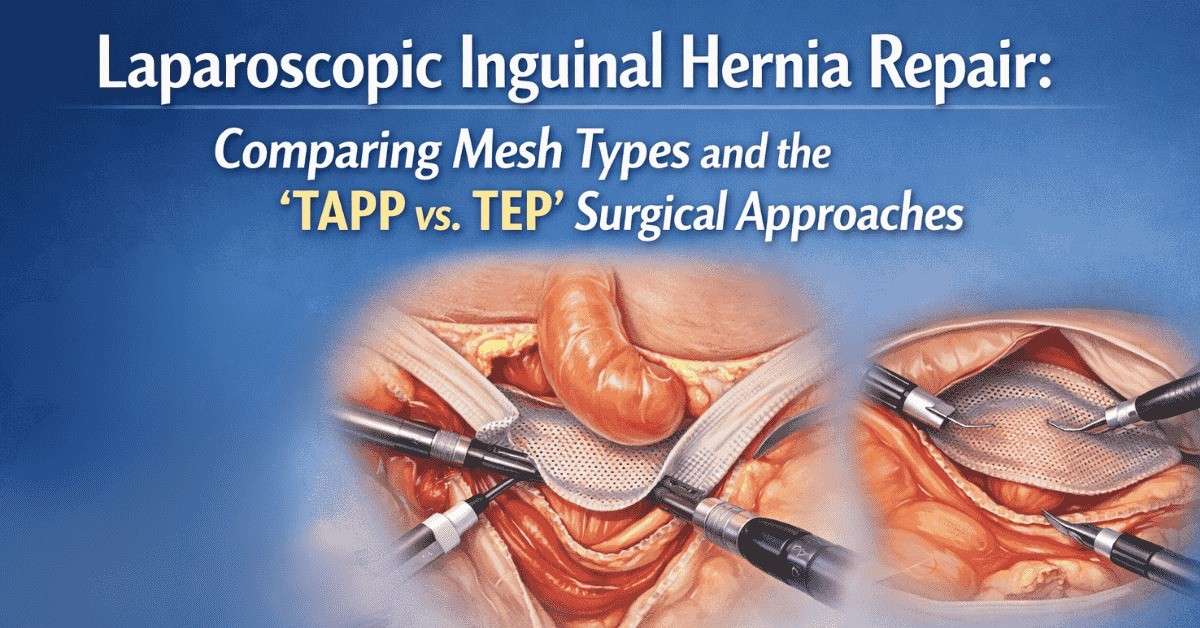
Laparoscopic hernia repair techniques utilize small incisions, a camera, and long instruments to repair hernias with mesh from within the abdomen. You achieve shorter hospitalizations, less post-operative pain, and a quicker return to work, typically within 1 to 2 weeks.
You experience fewer wound problems and reduced long-term risk of chronic pain compared to most open repairs. You get clear options: TEP, TAPP, and eTEP for groin hernias, plus IPOM for ventral cases.
Up next, you receive steps, risk, and recovery advice.
Key Takeaways
- You gain from a precise hernia diagnosis in that the proper type and location direct an optimal laparoscopic strategy. Ask your care team how your anatomy plays into the selected repair.
- You can expect less pain and faster recovery with laparoscopic repair due to smaller incisions and minimal tissue disruption. Plan for early mobilization and reduced analgesic needs.
- You resume regular activities earlier, with generally reduced hospital stays and decreased wound complication rates. Adhere to post-surgical guidelines such as gentle movement and wound maintenance.
- You could be a candidate for TAPP or TEP based on your hernia classification and history. Consider which approach suits your case in terms of visualization requirements, complexity, and surgeon experience.
- You reduce recurrence risk by using the proper mesh and fixation. Question them about mesh material, size, and placement strategy to optimize durability, comfort, and safety.
- You get better results with an experienced team of surgeons and state-of-the-art equipment. Select a surgeon with proven case volume and outcomes and establish a definitive preoperative checklist.

Understanding The Hernia Landscape
A hernia occurs when tissue from your abdomen protrudes through a weak area in the muscle wall. Frequently, types you’ll hear about are inguinal, ventral (including umbilical), femoral, incisional, and hiatal hernias. They can inhibit work, sport, and activities of daily living, and many are going to require surgery at some point.
Nailing down the exact site and anatomy is what fuels safe, durable repair and reduces complications.
The Anatomy
The abdominal wall is composed of skin, fat, deep fascia, and muscle layers including the external oblique, internal oblique, and transversus abdominis. Any weakness at these planes can lead to the formation of a hernia defect, allowing fat or bowel to slip through. Key landmarks include the inguinal canal, which is bordered by the inguinal ligament and the posterior wall, while the femoral canal lies below the iliopubic tract and medial to the femoral vein. Understanding these anatomical features is crucial for effective inguinal hernia repair.
The rectus abdominis has its sheath and linea alba, and the iliopubic tract is essential for groin mesh overlap. Revisiting foundational anatomic knowledge, the myopectineal orifice serves as the common weak zone in the groin, encompassing direct, indirect, and femoral spaces. To ensure a successful laparoscopic inguinal hernia repair, the mesh must adequately cover this orifice to seal every potential opening.
In the context of hernia surgery, it’s vital to recognize the paths through which different types of hernias pass. Direct hernias travel medial to the inferior epigastric vessels through Hesselbach’s triangle, while indirect hernias move lateral to these vessels, entering through the deep ring into the canal. Femoral hernias, on the other hand, pass below the iliopubic tract through the femoral canal.
By understanding these surgical operations and the anatomical structures involved, surgeons can effectively address abdominal wall defects. Utilizing laparoscopic techniques can minimize recovery time and postoperative complications, leading to better patient outcomes during procedures such as ventral hernia repairs and open hernia repairs.
The Diagnosis
You might feel or see a bulge, have aching after exertion, sharp stabbing pain, or nausea if the bowel is incarcerated. Bowel obstruction can lead to emergency treatment.
Diagnosis begins with a targeted exam as you stand and cough. Ultrasound is good for small groin or ventral defects. CT of the abdomen delineates complex or incisional hernias and prior surgical mesh.
You need the precise type and location to coordinate trocar placement, mesh width, and fixation. A history of prior operations, scars, or mesh shifts the landscape and influences the risk of enterotomy, reported as high as 6 percent in laparoscopic ventral repairs.
The Patient
Your age, weight, diabetes, smoking, and previous abdominal surgeries influence risks and approach. Your anesthesia fitness counts. Most otherwise healthy adults tolerate laparoscopy well.
Hernia size, content (fat vs bowel) and if it reduces will move options. Laparoscopy was less painful at one year in one study and similarly painful in another, with better physical function after lap repair.
Recurrences are similar for open and lap repair, around 1 to 10 percent, though non-absorbable transfascial sutures alone showed 0.5 percent in one large series. In ventral cases, infection is lower with lap repair at 2.8 percent compared to 21.9 percent for open repair, and cellulitis runs at 2 to 4 percent.
Pain is highly variable, but acute pain should resolve by 4 to 6 weeks and most of you go back to mild work at 2 weeks.
Your Pre-Op Checklist:
- List comorbidities and meds (include anticoagulants).
- Stop nicotine; manage glucose.
- Note prior mesh, scars, and symptoms with strain.
- Discuss risks: enterotomy up to 6 percent ventral, chronic pain, recurrence.
- Align goals: pain relief, faster recovery, activity timeline.
Why Choose Laparoscopic Repair?
You receive the minimally invasive advantages of laparoscopy over open repair — small incisions (typically 5–10 mm) and minimal muscle splitting. That reduces tissue trauma and accelerates recovery. Research shows less pain, fewer wound problems, and comparable or lower recurrence when mesh is placed in a preperitoneal plane.
You get advantages for bilateral or recurrent groin hernias, where laparoscopy sidesteps new big incisions. Indications typically include primary or recurrent inguinal hernia, bilateral hernias, occult contralateral hernia identification, and ventral or incisional defects amenable to minimally invasive mesh deployment. Complication rates for wound infection, hematoma, and chronic pain are usually less. Long-term function and return to work are better.
Less Pain
You’re less sore after laparoscopic hernia repair than after open surgery. Small ports and less tissue pull cut nerve and muscle irritation. That’s the primary motivation.
The majority of patients require fewer strong pain pills and turn to paracetamol or ibuprofen quickly. Less pain has you standing, walking, and breathing deeply sooner, which reduces other risks and gets you back to daily life.
Faster Recovery
Most patients are home that day or within 24 hours of laparoscopy. You return to desk work in days, not weeks, and light sport in 2 to 3 weeks, which is sooner than normal open timelines.
Lower wound infection and seroma rates are associated with the small incisions and internal mesh placement.
| Approach | Typical stay | Back to desk work | Light sport |
| Laparoscopic | 0–1 day | 3–7 days | 2–3 weeks |
| Open | 1–3 days | 2–4 weeks | 4–6 weeks |
Better Cosmetics
Ports are tiny and frequently positioned near the navel or along the groin crease, where they disappear into natural lines. There’s less scarring and a smoother abdominal wall, which counts if you wear tight clothing or swimsuits.
Patient scores for appearance are higher after laparoscopy in many series. Add captioned before and after photo pairs or plain line drawings to illustrate scar size and placement.
Bilateral Repairs
Laparoscopy allows your surgeon to repair both sides with the same ports in one setting and with no new incisions. You’re not under anesthesia as long, and recovery is easier as both repairs heal simultaneously.
The risk of complications from a second surgery is avoided.
- One anesthesia, one recovery
- Fewer wounds, less pain
- Shorter total time off work
- Lower overall cost of care (fewer visits)
How Is Laparoscopic Hernia Repair Performed?
You have a stepwise procedure under general anesthesia. We establish reliable access to your abdomen, inflate it with carbon dioxide to make room, then use a camera and slender instruments to identify the defect, free the sac, insert mesh, and close.
During the procedure, the surgeon identifies landmarks, safeguards vessels and nerves, and records main findings.
1. Preparing For Surgery
You fast for 6 to 8 hours, modify blood thinners or diabetes drugs as scheduled, and conduct bowel prep only if your case requires. The skin is marked over the hernia and your previous surgeries and imaging are considered to plan entry points.
You’re put on your back, then cradled for a steep Trendelenburg later. The abdomen or groin is prepped with an antiseptic and draped for a sterile field.
Set-up consists of a 10‑mm, 30° laparoscope, two 5‑mm graspers or dissectors, an energy device, atraumatic forceps, a tacker or glue system, a balloon‑tip port (11 mm), and a lightweight, large‑pore mesh sized to cover the myopectineal orifice.
2. Creating The Workspace
The surgeon makes three keyhole cuts: one 1 cm at the navel for the scope and two 0.5 cm for tools. After safe entry and pneumoperitoneum, trocars are inserted under vision, and you are positioned in steep Trendelenburg to allow the bowel to fall away.
Access can be transabdominal, preperitoneal or totally extraperitoneal. A blunt 11-mm balloon-tip port inflates the preperitoneal space. Dissection continues layer by layer, revealing landmarks.
Clear views are confirmed before repair. The gonadal vessels and vas deferens are on the lower left, and Cooper’s ligament is on the lower right.
3. Identifying The Hernia
The surgeon maps the defect, sac, and contents. Indirect sacs frequently rest anterolateral to the cord.
Direct, indirect, and femoral types are differentiated and occult or bilateral defects are identified. Key images are taken for your chart.
4. Placing The Mesh
Match mesh type and size to your defect and approach. It should overlap the entire myopectineal orifice and all potential spaces.
Fixation employs tacks or glue as necessary. Tails are affixed to Cooper’s ligament with 2 tacks, taking care to avoid the accessory obturator vein.
Final scope check: flat, full coverage, no folds.
5. Finishing The Procedure
The peritoneum is closed to protect the mesh and prevent adhesions. Instruments are withdrawn, gas is vented under vision, and small incisions are closed with glue or absorbable sutures.
Sterile dressings are placed and operative notes document findings, mesh type, and fixation. Generally, there are small scars, little pain, short stays, and a rapid return to daily activities.
Tapp Versus Tep Techniques
There are two primary laparoscopic approaches for groin hernia repair. TAPP goes through the peritoneal cavity to access the preperitoneal space. TEP remains outside the peritoneal cavity and operates exclusively in the extraperitoneal plane. They both introduce mesh in the same anatomic layer; they just take different routes to get there.
The decision depends on anatomy, hernia type, your risk profile, and the surgeon’s expertise.
| Feature | TAPP | TEP |
| Access plane | Through the peritoneal cavity to the preperitoneal space | Direct to the extraperitoneal space |
| Visualization | Broad intra‑abdominal view | Focused preperitoneal view |
| Organ injury risk | Slightly higher (bowel/bladder) | Lower intra‑abdominal risk |
| Port-site hernia | 0.8–3.7% | ~0% reported in one study |
| Op time | Slightly longer | Approximately 6 minutes shorter (mean) | | Indications | Complex, recurrent, uncertain anatomy | Primary, straightforward inguinal | | Pain, recurrence, complications | Similar among techniques | Similar among techniques |
The Tapp Approach
You access the peritoneal cavity, fashion a peritoneal flap, expose the myopectineal orifice, and apply mesh on top of the hernia defects. You then close the peritoneum over the mesh and seal the field.
You get complete exposure to intra-abdominal contents, facilitating your management of previous scarring, occult femoral hernias or bilateral disease. This vantage can expose surprises like a sliding hernia or adhesions.
The tradeoff is a minor but actual risk of bowel or bladder injury and port-site hernia. Case series report vascular injury close to 0.5 percent. All complications hover around 1.8 percent.
TAPP is suitable for complicated or recurrent hernias, previous preperitoneal mesh, or indeterminate planes on imaging.
The Tep Approach
You develop in the extraperitoneal plane and never enter the peritoneum. Mesh lies in that same preperitoneal position, just with a stay outside approach.
This decreases intra-abdominal organ injury and may decrease postoperative ileus. Vascular injury rates are comparable, approximately 0.47%, although some studies report ranges of 0 to 7% without meta-analytic validation.
The difficulty is the limited working space and a steep learning curve. Little errors can quickly blacken the field.
TEP is often selected for primary, simple inguinal hernias with marginally shorter operations and no port-site hernias in one study.
Which Is Better?
You balance anatomy, hernia type, previous operation, obesity, blood thinners and surgeon familiarity. Pain is comparable early after surgery with a mean difference of 0.08 and a 95% confidence interval from -0.29 to 0.45 with a P-value of 0.67.
Recurrence demonstrated no significant difference with a risk ratio of 2.59 and a 95% confidence interval from 0.11 to 60.69. Complications are around 1.8%, including vascular injury.
TEP goes faster with a time difference of 6.3 minutes and approaches zero port-site hernia. Return to sport at 3 months is 94% in both.
The Critical Role Of Mesh
We use mesh in the vast majority of laparoscopic hernia repairs for the same reason: it reduces recurrences by giving the abdominal wall a wide, uniform support. Contemporary designs reduce tension on sutured edges, distribute load over centimeters of tissue, and reduce operative time in numerous contexts. Technologies have transitioned from heavyweight, small-pore polypropylene to lightweight, large-pore synthetics, absorbable barriers for intraperitoneal placement, and biologic scaffolds.
Results improved: fewer recurrences, better handling, and more precise placement. Choice still counts in neat-dirty arenas. A study of 33,832 patients discovered increased wound complications with mesh at 21.2 percent versus without at 17.5 percent. Key points when you choose mesh:
- Material: synthetic vs biologic, permanent vs absorbable barrier
- Size: Cover defect with a minimum of 3 to 5 centimeters overlap in all directions.
- Compatibility: match to location, contamination risk, patient factors
Mesh Materials
Synthetic mesh (e.g., polypropylene, polyester, ePTFE) provides durable strength, good flexibility, and dependable pore structure. Biologic mesh (derived collagen) provides a remodeling scaffold with reduced foreign body burden in contaminated fields. It frequently has less long-term strength and increased cost.
Flexibility and strength determine the manner in which the repair supports everyday tension. Some large-pore, lightweight synthetics mesh well and may soften stiffness. Biologics incorporate with host tissue but can elongate over time, potentially increasing recurrence risk in high-tension locations.
Infection and foreign body response remain a worry. Late mesh infections can present between 30 days and up to 1 year, so schedule extended follow-up.
- Synthetic: strong, cost‑effective, broad data; higher risk if contamination
- Biologic: better in contamination risk; lower durability; expensive
Mesh Fixation
You can secure mesh with tacks, sutures, glue, or self-adhering surfaces. In ventral hernia laparoscopy, appropriate position and fixation are key steps. You should position patients for sterile access to the abdominal wall.
Safe grasp must not come at the expense of nerve pain. Select fewer, strategically located points. Steer clear of nerve pathways. Adjust method to site and build: groin versus midline, thin versus thick wall. Protect nerves and vessels by identifying landmarks clearly and using pre-op imaging as necessary.
Early QoL differs with tack, staple, or suture peritoneal closure in TAPP. Suturing principles for ventral or incisional repairs are encouraging.
Mesh Controversies
You encounter controversies on persistent pain, long-term safety, and infrequent occurrences such as migration, erosion, and infection related to hernia surgery. Recalls and litigation create panic; mention device details, as the defect size is less than 10 percent of surgeons who place prosthetics for defects smaller than 3 centimeters. Data show that mesh reduces recurrence even with small umbilical hernias, particularly in laparoscopic inguinal hernia repair.
Data demonstrate increased wound complications with mesh in any contamination, and many recommend avoiding mesh in the presence of contamination. A huge prospective study with 710 participants found worse quality of life at 1 month after laparoscopic ventral hernia repair, but no difference after 6 months compared to open hernia repairs.
Migration and erosion risks are low with proper planning, size, and overlap. Be on the lookout for late infections and put check-ins at one year.
Current guidance: Use mesh for most clean cases, pick plane and material to anatomy, ensure at least 3 to 5 centimeters overlap, and tailor fixation to limit pain.
The Surgeon’s Crucial Influence
Your outcome following laparoscopic inguinal hernia repair largely depends on your surgeon’s expertise, experience, and discretion. Their experience significantly influences the risk of hernia recurrence, chronic groin pain, and your recovery speed. The choice of laparoscopic techniques, mesh use, and anesthesia plans all relate back to their training and continuous education.
The Learning Curve
Teams beyond the early learning curve should see superior results. Mastery requires deliberate practice and feedback.
Research indicates skill increases nonlinearly. A meta-analysis of 22 studies demonstrated a year-on-year performance gain of around 2.7% with fewer mistakes and quicker times as cases accrue. Most programs aim for 50 to 100 supervised cases to stabilize operative time and complications, but complexity and case mix are significant.
Early pitfalls are things like bad mesh sizing, suboptimal preperitoneal dissection, missed hernia sites, and nerve or vessel injury. Checklists, step mapping, and video review can help. Meticulous identification of landmarks and atraumatic tissue handling help reduce the risk of chronic pain.
Even new surgeons do better with structured mentorship, dry-lab drills, and simulation that rehearses port placement, hernia reduction, and mesh fixation choices.
The Technology Factor
You win when your team has access to a high-definition endoscope measuring between 5 and 10 mm, atraumatic graspers, precise energy devices, and dependable fixation tools. Good light and 3-chip cameras enhance tissue planes.
Enhanced imaging, including 3D visualization, can hone depth cues and reduce mistakes in confined quarters. This can translate to cleaner dissection and fewer nerve touches.
Minimally invasive tools reduce pain and wound problems. Laparoscopic repair exhibits less chronic pain at 7.6 percent than open mesh at 12.7 percent, and a more rapid return to daily activities.
Robotic-assisted repair can assist with suturing and ergonomics. It can assist in large, recurrent, or complicated defects, yet cost and availability differ.
The Experience Impact
About the surgeon’s critical role in hernia surgery — larger surgical volume correlates with less recurrence and complications. Experienced teams complete procedures earlier, utilizing laparoscopic techniques for gentler anesthesia, resulting in reduced nausea and better pain control. In certain populations, epidural anesthesia has notably decreased painkiller requirements.
Judgment is crucial in emergencies. In one series, just 11.1% required bowel resection, underscoring the importance of expert care. Your surgeon’s decisions, such as choosing between laparoscopic inguinal hernia repair and open hernia repair, significantly impact your pain, recurrence, and recovery time.
Fixing the residual hernia sac has been shown to decrease repeat seroma aspirations in some studies. Anticipate teams to monitor outcomes, audit recurrences, and engage in study groups, highlighting the surgeon’s vital impact.

Conclusion
You get the picture of what makes laparoscopic hernia repair so special. Small incisions, less discomfort, and a quick return to work or home life. Defined steps in the OR. Robust mesh options are true advancements you experience within the first week.
TAPP fits cases with ambiguous imaging or previous abdominal surgery. TEP repairs simple groin hernias with minimal scar potential. An experienced hand makes each step secure and clean. Inquire about case volume, mesh type, and pain plan. Try, for example, “How many TEP versus TAPP do you do each month?” or “What fix do you use for mesh?
To take a wise next step, consult with a board-certified surgeon who sees hernias regularly. Schedule a consultation, bring your objectives, and receive a personalized plan.
FAQ
What types of hernias are best suited for laparoscopic repair?
Most groin (inguinal) hernias, some ventral hernias, and recurrent hernias benefit from laparoscopic inguinal hernia repair. This approach is perfect for quicker healing, reduced discomfort, and minimized scarring, while open hernia repair may be necessary for large or strangulated hernias.
Why should you choose laparoscopic hernia repair over open surgery?
You typically experience less pain, fewer wound complications, and a faster return to normal activity after laparoscopic inguinal hernia repair. You have smaller scars, and both sides can be repaired through the same small incisions, depending on your hernia defect.
How is laparoscopic hernia repair actually performed?
During laparoscopic hernia surgery, your surgeon makes small incisions and inflates the abdomen with gas, using a camera and instruments to position mesh over the hernia defect. This laparoscopic approach fortifies the abdominal wall, allowing you to return home the same day.
What is the difference between TAPP and TEP?
TAPP, a laparoscopic approach, goes through the abdomen and implants mesh behind the muscle, while TEP remains extraperitoneal in the preperitoneal space. Results are comparable in the hands of specialists, with selection based on hernia location, anatomy, previous surgery, and the surgeon’s expertise.
Is mesh necessary in laparoscopic hernia repair?
In most mature adults, laparoscopic inguinal hernia repair using mesh reduces the recurrence risk of a hernia coming back. The new meshes are ultra-lightweight and designed specifically for strength and comfort, making them ideal for ventral hernia repairs.
How does the surgeon’s experience affect your results?
Seasoned laparoscopic surgeons have significantly reduced recurrence and complication rates through effective laparoscopic inguinal hernia repair techniques. They select the appropriate mesh size, tailor their approach, and safeguard nerves and vessels. Inquire about case volume, outcomes, and complication rates before you make your decision.
How long is the recovery after laparoscopic hernia repair?
Most people walk the same day and resume light activity in 2 to 3 days after hernia surgery. Many return to work in 1 week, but it’s advisable to avoid heavy lifting for about 2 to 4 weeks based on your surgeon’s advice to prevent hernia recurrence. Pain is usually mild and managed with simple medications.

 Jenny4931 says: