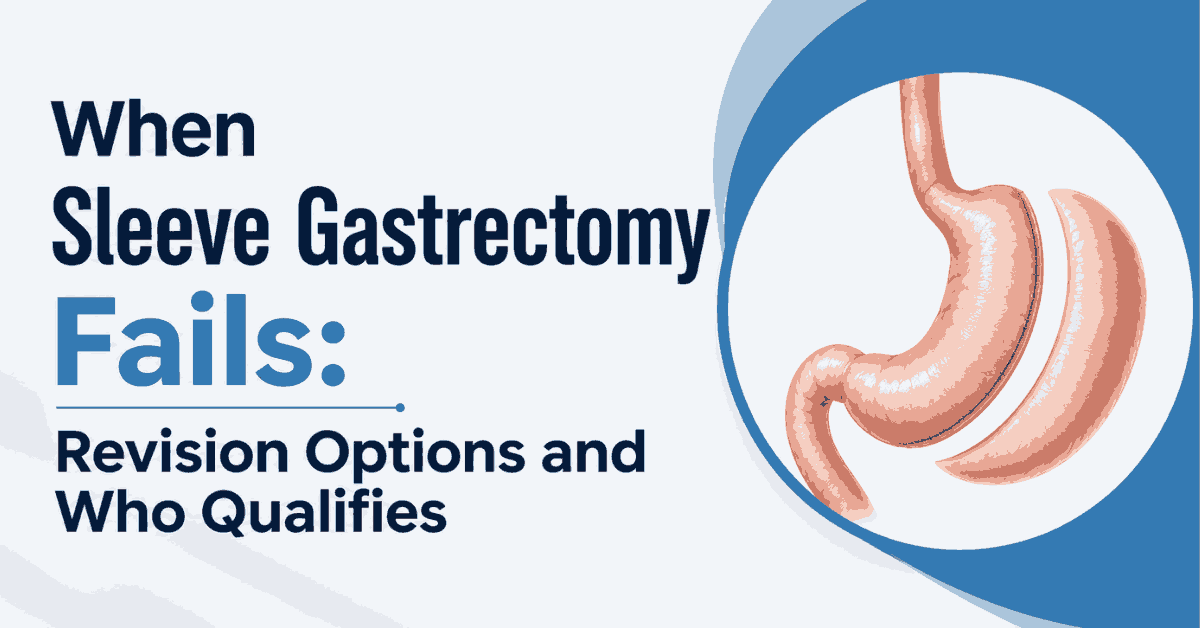
Gastric sleeve surgery can provide significant weight loss and health benefits, but results may not always last. Weight gain, insufficient weight loss, severe reflux, sleeve dilation, or other complications may lead to gastric sleeve revision surgery.
Revision surgery is more complex than the original procedure and requires careful evaluation of your health, anatomy, weight history, and goals. This guide covers revision options, eligibility, and what to expect before, during, and after surgery.
Here are the key points to keep in mind:
Key Takeaways
- You may be a candidate for gastric sleeve revision if you have regained weight, have insufficient weight loss, suffer from severe reflux, or have medical complications. Acting early can safeguard your long-term health. Keep track of your weight, symptoms, and quality of life so you can have specific issues to bring to your bariatric team.
- You have multiple revision options including re-sleeve, conversion to gastric bypass or duodenal switch with various pros and cons. Work with an expert who can tailor the procedure to your anatomy, weight loss goals, and any complications you have.
- You are a more likely candidate for revision surgery if you undergo a full medical workup for weight management, psychological screening, and lifestyle changes. Consult a checklist of eligibility criteria and questions during conversations with your care team.
- Your revision journey has specific milestones with pre-operative testing, surgery, hospital stay, and organized follow-up. Maintain a progress checklist during surgical procedures so you can view what you’ve gotten through and what’s coming at each stage.
- Your recovery involves a staged diet to prevent weight loss , incremental exercise, and emotional support. Nutrition, movement, and mental health resources are important. Plan ahead of surgery for a smoother recovery and weight management.
- You require reasonable expectations as revision surgery can be more complex and have higher risks than primary bariatric procedures. Concentrate on long-term habits and follow-up care instead of short-term results to increase your likelihood of sustained success.
Gastric sleeve revision surgery is a secondary weight loss solution you require when your initial sleeve ceases to provide secure or consistent outcomes. You could experience weight gain again, persistent reflux, or minimal weight loss years after having a sleeve.
Some require resizing of the sleeve while others transition to a bypass or alternative. Next, you’ll learn how revision surgery works, its risks, and what to anticipate.
Why Consider Gastric Sleeve Revision?
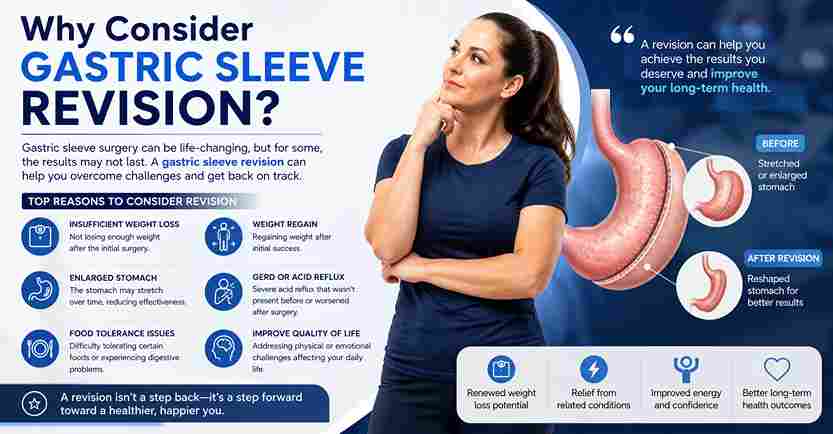
Gastric sleeve revision enters the picture when your initial surgery no longer provides you with secure, consistent outcomes. You might experience weight regain, suboptimal weight loss, or new medical issues like severe reflux or pain. A revision is designed to correct these problems, enhance long-term weight management, and safeguard your health to prevent gastric bypass revision, not to undo your previous commitment.
1. Weight Regain Using Weight Management
Weight regain is the most common reason you’ll consider revision post-sleeve gastrectomy. Research finds that as many as 7 out of 10 people experience some gain by around three years, even if the initial year was successful.
Your body reacts to weight loss by adjusting, slowing your metabolism and making it easier to put the weight back on. Daily habits count as well. Nibbling on calorie-dense treats, sweetened drinks, or consuming large portions can gradually nudge your weight back up, even with a reduced stomach size.
For example, if you have a sleeve, revising it to a gastric bypass can limit what you consume and the calories you absorb. If your sleeve has stretched, re-sleeving can help restore the restriction. Surgery alone isn’t going to take you. You still require a defined eating plan for weight management, consistent exercise, and follow-up care with a dietitian and frequently a behavioral therapist both pre and post surgery.
2. Insufficient Loss After Revision Surgeries
If you never hit significant weight loss post first sleeve, revision could be in the cards. For others, the sleeve was too wide to begin with or the stomach was fashioned in a way that was not restrictive enough.
In some cases, medical conditions, certain medications, or deep-rooted eating habits stall weight loss. Revision options can involve tightening or re-creating the sleeve or converting to another bariatric procedure like gastric bypass.
Careful monitoring of your health condition and weight to prevent weight loss procedure defend obesity too , food intake, and symptoms with your care team helps indicate whether the issue is primarily surgical, lifestyle-related, or both and if another surgery is likely to assist .
3. Sleeve Dilation After Surgical Procedures
Sleeve dilation means your stomach sleeve has dilated over time, so it contains more food and provides less satiety. You may find you’re able to eat much bigger portions than during that initial year after revision surgeries can help in better health condition.
You may sense your hunger returns more quickly between meals. A dilated sleeve is the culprit for weight gain or increased hunger even years after surgery. Sometimes, imaging or endoscopy will show that the sleeve is wider than anticipated.
Revision could be re-sleeving to cut the enlarged portion or converting to gastric bypass surgery for additional restriction and some malabsorption. If you notice an increase in portion sizes or persistent hunger, it’s time to schedule a complete work-up, not just “try harder” on your own health.
4. Severe Reflux
Severe acid reflux (GERD) after sleeve surgery is another common indication for revision. Some experience new heartburn and others see their pre-existing reflux intensify.
If you experience daily burning behind your breastbone, sour fluid coming into your mouth (regurgitation), coughing at night or painful swallowing, don’t ignore it. Long-term acid exposure can scar the esophagus.
When potent acid-reducing drugs and lifestyle adjustments can’t manage symptoms , your team might recommend converting the sleeve to a gastric bypass, which tends to decrease reflux and. Reflux revision can relieve pain, restore quality sleep and meals, and reduce the risk of chronic esophageal damage.
5. Medical Complications
Other issues post-gastric sleeves are more severe and require immediate revision. These consist of staple line leaks, deep ulcers, sleeve strictures or internal hernias entrapping portions of the stomach or bowel.
You may experience persistent abdominal pain, chronic nausea or frequent vomiting even if you adhere to your plan. Revision surgery in these cases may fix damaged tissue, remove scar tissue, treat ulcers, or convert you to a different bariatric procedure that is safer for your anatomy.
Because revision is often more complicated than the initial surgery, you and your surgeon need to evaluate the risks and potential benefits with realistic figures, not guesswork. In most cases, this involves collaborating with a dietitian, behavioral therapist, and your medical team to clean up eating habits and treat emotional triggers prior to proceeding.
This helps ensure surgery is the appropriate course, not a fast fix for problems that are largely lifestyle-based to prevent revision surgeries
 .
What Are Bariatric Revision Surgery Options?
It’s not cookie cutter. Every solution addresses a particular issue, be it sleeve stretching, reflux, or significant weight gain, and the “correct” option depends on your specific anatomy, previous outcomes, habits, and current fitness.
| Revision type | Main benefit | Key risks / downsides | Typical extra weight loss* |
| Re-sleeving | Restores stomach restriction | Leak, bleeding, reflux, scar tissue issues | Often modest; mainly stops further regain |
| Convert to gastric bypass | Helps reflux + weight regain | More complex surgery, vitamin lack, ulcers | ~20–30% of total body weight |
| Duodenal switch | Greatest weight loss, strong metabolic gain | Highest surgical and nutrition risks | Often >30% of total body weight |
| Endoscopic sleeve revision | No cuts, fast recovery | Less weight loss, may need repeat | ~15–20% of total body weight |
Differences depend on study, habits, and health.
Revision surgery is nearly always more complicated than your initial bariatric surgery, and it’s not always the initial action. If weight regain relates to snacking, sugary drinks, or sedentary activity, your care team may press hard on lifestyle and medical therapy before they discuss the OR.
Re-Sleeving
Re-sleeving involves your surgeon excising the stretched-out part of your sleeve and making it small again, so food has to pass through a narrower tube and you feel full on less food.
You’re more likely a candidate for re-sleeve if your primary concern is a dilated sleeve on scans, you don’t have bad reflux, and you don’t have any other major complications such as ulcers or leaks.
In many programs, about 20 percent of the revision cases are re-sleeves, typically for individuals who initially lost well and then gradually put it back on as the sleeve expanded.
This option is typically less invasive than converting to bypass or duodenal switch, but it’s still real surgery. Complications are leaks along the stapler line, hemorrhage, infection, and obstruction from scar tissue.
Gastric Bypass To Prevent Revision
As a revision, a gastric bypass constructs a mini stomach from the upper portion of your stomach and then attaches it directly to your lower small intestine so that food bypasses most of your stomach and upper bowel.
Conversion to bypass is typically selected when you have both weight regain and strong reflux that does not settle with medication. It can assist with type 2 diabetes, high blood pressure and sleep apnea, making it a robust long term device when restriction alone falls short.
Bypass revision is trickier than a first-time bypass because the surgeon operates around scar tissue and old staple lines. It requires high skill and meticulous organization.
There are two main ways to revise an existing bypass if it later fails: surgical revision and endoscopic revision. Surgical revision could reduce the size of your pouch again, tighten the outlet, repair leaks, repair ulcers, or alter intestinal flow.
Endoscopic revision is incisionless and performed with a scope down your mouth. It usually takes less than 30 minutes and can shrink the pouch or outlet from the inside.
Duodenal Switch
A duodenal switch revision combines a restricted sleeve-type stomach with a serious intestinal reroute, so that your body ends up absorbing significantly less calories and nutrients.
This path is typically reserved for individuals with morbid obesity, significant metabolic disease, or those who didn’t respond adequately to other treatments. It provides the greatest average weight loss and greatest impact on diabetes, but it has its trade-offs.
The risks are higher. Longer surgery, more stress on your body, more chance of leaks or blockages, and a real risk of protein lack and vitamin and mineral gaps.
You require rigid follow up, frequent blood tests, and daily supplements for life, in addition to careful monitoring of protein and hydration.
One long-term study of revision (different types) found that approximately 7 out of 10 people deemed their outcomes a success after three years. That reflects how they adhered to nutrition, exercise, and aftercare.
Are You A Suitable Candidate?
Gastric sleeve revision surgery candidacy is based on a comprehensive health profile, not a single metric. They will review your medical history, current health, why you had the initial sleeve and how your body and weight have responded since. They go over any issues from the initial surgery and how these impact your life day to day.
Usual suspects are your BMI, obesity comorbidities, inability to achieve or maintain weight loss, and documented problems with the original sleeve. Bariatric surgery is an option if you live with obesity and have not achieved durable results with diet, exercise, or medical weight care alone. A BMI of 40 or more, or 35 or more with issues like type 2 diabetes, hypertension, sleep apnea, or fatty liver, is a common baseline but not the only baseline.
A simple checklist you can start to compile:
- Recent BMI and weight direction over the last one to two years.
- Obesity-related diseases such as type 2 diabetes, joint pain, and insulin resistance.
- Previous weight-loss attempts, such as supervised diets, medications, and programs, and their effectiveness.
- Issues from the initial sleeve include reflux, strictures, leaks, severe nausea, and difficulty eating.
- Diets, exercise, and shift work or travel that disrupt routine.
- Mental health history, drug and alcohol usage, and support at home and work.
Two people with the same BMI may have very different health risks, habits, and metabolic issues, so suitability is never “one size fits all.” You need a full evaluation of your current health and the severity of your obesity to see if revision surgery adds real benefit and reasonable risk. A bariatric professional has to tie all these pieces together before saying revision is right for you.
Medical Evaluation For Revision Surgeries
Your medical clearance examines what condition your body is in today and how your initial procedure has transformed your stomach and intestines. You’ll probably have a physical exam, blood tests to examine anemia, kidney and liver function, vitamins and hormones, as well as imaging such as abdominal ultrasound or CT scan.
Most teams use a contrast X‑ray study or endoscopy to view the form and size of your sleeve, screen for hiatal hernia, and check for ulcers or severe reflux damage. If you have weight regain or bad weight loss, your crew will seek out root causes like a stretched sleeve, a wide antrum, or accelerated gastric emptying .
They will examine any issues from your first operation, such as leakages that closed with scarring, food-trapping strictures or twisting and kinking that delayed emptying. These anatomic changes can direct if you need a re-sleeve, conversion to another bariatric procedure, or non-surgical care.
Key steps in a typical medical work‑up include:
- Detailed medical and surgical history review
- Physical exam and vital signs
- Blood tests (metabolic panel, blood count, vitamins, hormones)
- Imaging (ultrasound, CT, contrast swallow) as needed
- Upper endoscopy to inspect the sleeve and esophagus
- Sleep study or heart tests if at higher risk.
- Final risk–benefit review and written plan for weight regain
Psychological Readiness
Psychological preparedness influences your management of a second bariatric surgery. You’ll probably see a mental health professional who’s familiar with bariatric patients. They screen your mood, anxiety, trauma history, substance use, and coping skills.
They consider coping skills, daily support, and your reaction when things go wrong. The other big component is your relationship to food and your body. If you frequently eat to calm stress or oscillate between extreme dieting and momentum lessness, you require assistance pre and post revision.
Not to criticize you, to ensure you have tools that align with the rigors of yet another surgery. Most teams employ some type of formalized instruments, such as standardized mood scales or eating-behavior questionnaires, to ensure the process is equitable and transparent.
You might even be provided with therapy or support groups to address emotional eating, mourning over past weight issues, or false expectations on what surgery by itself can resolve for you.
Commitment Level
Revision surgery has no reset button. It’s another instrument. You require a robust long-term strategy for how you’ll eat, move, sleep and check in with your squad. That means established meal habits with sufficient protein, defined boundaries around high-sugar beverages and treats, and a feasible exercise schedule that accommodates your age, joints, and working style.
Even short daily walks or low-impact exercise will assist when applied with some consistency. You need to be okay with regular check-ins: early post-op visits, yearly blood work, and quick contact if problems show up. Several centers have you sign up for a structured weight-loss or support program, in-person or online, to keep you on track and provide a home base for asking questions.
If you know now that you blow off doctors appointments or diet recommendations for months at a time, it’s worth discussing this before you commit to revision. Your compliance to post-surgical rules, such as chewing well, taking supplements, not smoking, limiting alcohol, and calling early when something feels off, impacts your long-term safety and outcomes.
In other words, what you do every day post-op will be more important than the precise manner in which the surgeon reconfigures your stomach.

The Revision And Weight Loss Surgery Journey
The revision journey moves in clear stages: careful evaluation, structured testing, surgery with a tailored approach, and close follow-up. You collaborate with a complete bariatric team—surgeon, anesthesiologist, dietitian, psychologist, and nurses—who monitor your health, weight patterns, and causes for revision, including refractory obesity, which accounts for approximately 87.0% of scenarios, or reflux symptoms, which account for around 5.2%.
A simple checklist to track your path:
- Referral and first consult
- Review of old surgery notes and weight history
- Pre-operative tests and clearances
- Nutrition and mental health review
- Final consent and surgery date set
- Hospital stay and early recovery
- Follow-up visits and long-term lifestyle support
Pre-Operative Tests And Revision Procedure
Preoperative Optimization– Prior to revision, your team searches for anything that might increase your risk during or following surgery. This means, among other things, monitoring your heart, lungs, blood count, and vitamin levels, and taking a look at your history, in particular, if you’d previously had a gastric band, which is linked with increased risk of revision with a hazard ratio close to 2.81.
You consult a dietitian and a psychologist. They monitor your nutritional habits, coping mechanisms, and support network so you enter surgery with reasonable expectations and a defined plan.
Common tests and why they are done:
- Blood work includes anemia, kidney and liver function, vitamins, and blood sugar.
- Electrocardiogram (ECG): heart rhythm and cardiac risk.
- Chest X-ray or lung tests are important for assessing lung health and ensuring anesthesia safety.
- Imaging (ultrasound or contrast X-ray): the shape of your current sleeve or bypass.
- Upper endoscopy: ulcers, strictures, leaks, inflammation, reflux damage.
- Psychological evaluation: eating patterns, mood disorders, substance use.
- Nutrition assessment: protein intake, vitamin gaps, weight-loss history.
Surgical Technique
Almost all revisional operations are performed with laparoscopic instruments through tiny incisions. Open surgery may still be required for extremely complicated cases or when there is extensive internal scarring from previous surgeries. This is one reason revisional surgery is often more difficult than the primary procedure.
Under general anesthesia, the surgeon employs a camera and fine instruments to operate with greater precision near old staple lines and scar tissue. The specific approach depends on your anatomy and what went awry with the initial sleeve.
Revision surgery aims to re-sleeve a stretched stomach. Conversion to gastric bypass or duodenal switch can alter the transit of food through your intestines and the calories you absorb. For certain gastric bypass revisions, the surgeon can take an endoscopic approach, maneuvering a flexible tube equipped with a camera and tools down your throat and into the stomach to constrict an outlet, repair ulcers, or address leaks without making new incisions.
Revision can even be aimed at fixing leaks, ulcers, or reshaping the pouch so it is small once again. Your surgeon explains the benefits and trade-offs of each alternative, how the new anatomy can impact weight loss, and how it influences your lifetime vitamin requirements. Such a step-by-step review helps tailor the surgical plan to your history, health boundaries, and risk profile.
Hospital Stay
Most patients are in the hospital for one to two days. This can extend if your revision is complex or if you’ve had prior issues like leaks or bleeding. Nurses and doctors monitor your heart rate, blood pressure, pain, and signs of trouble during this time.
They watch for known risks after revision: gastric leak seen in around 5.1% of cases, bleeding about 18%, and the need for another early reoperation around 6.4%. You begin with clear liquids with supervision and your team verifies that you can drink without significant pain, nausea, or potential leak symptoms.
Before you go, you receive written guidelines that include wound care, pain pills, blood thinners if necessary, and when to walk, work, or lift heavy objects. You receive a follow-up and lab schedule, which is important as revision cases are more complex over the long term, with sleeve revision rates ranging from 4.7 percent, 7.5 percent, and 12.2 percent at 5, 7, and 10 years.
Approximately 60 percent of patients shed a minimum of 50 percent excess weight after revision, which your team will gauge and monitor over time.
Navigating Your Recovery Path
Recovery after gastric sleeve revision proceeds in phases. Each phase has you modify your eating, movement, and emotional management as you comply with your care team’s protocol for safe healing and consistent weight loss.
| Recovery Phase | What to Expect | Key Focus |
| Hospital & first 3–5 days | Pain control, walking, clear liquids | Safety, hydration, preventing blood clots |
| Weeks 1–2 | Full liquids, protein shakes, slow walking at home | Hydration, protein, wound care |
| Weeks 3–6 | Pureed then soft foods, more walking and light daily tasks | Tolerance, vitamin routine, gentle strength |
| Months 2–6 | Move toward regular food in small portions, build exercise routine | Habits, portion control, emotional support |
| Beyond 6 months | Long-term lifestyle pattern, weight and health monitoring | Consistency, follow‑ups, mental well‑being |
Recovery takes time. You may be feeling impatient, but adhering to instructions, attending follow-ups, and seeking assistance when required will define your long-term outcome.
Diet Progression To Control Obesity
You begin on clear or full liquids, then progress to purees, soft foods, and then to regular textures in very small quantities. You may lean on protein shakes every day at first, which can help you hit protein targets and limit muscle loss. Discovering one you genuinely enjoy makes this way easier to maintain.
Your dietitian’s plan is more important post revision than post first-time surgery, since your stomach has already been altered once. You need a plan constructed for your history, your labs, and your body’s response, not an off-the-shelf online timetable.
The habits you establish in the initial 6 months, such as consuming protein before other nutrients, taking small bites, and alternating utensils between bites, are powerful indicators of your long-term success years down the line.
Hydration is mandatory. Dehydration is a leading cause of readmission. Try to sip water or sugar-free fluids throughout the day, not in large gulps, and log your consumption if necessary. Daily vitamins for life are important too. Reminders on your phone or next to your toothbrush will keep you on track and help prevent anemia or bone loss.
Be on the lookout for warning signs when you transition from one food stage to another. Nausea, new or sharp belly pain, vomiting, or strong bloating after a few spoonfuls could indicate that the food is too thick, the serving is too large, or something else is amiss.
If symptoms persist even if you decelerate and chew thoroughly, reach out to your team rather than powering through.

Physical Activity For Weight Management
Immediately post-op, movement equals safety, not conditioning. Even just having assistance to get out of bed, sit in a chair, and take slow walks around the hallway on day one reduces your risk of blood clots and helps your lungs function better, which can make healing faster and decrease gas pain.
At home, numerous individuals employed brief walks about the room or corridor a few times daily as their starting point. Over the following weeks, you incrementally add more distance and time as your body permits.
Walking is often the foundation since it’s low-impact and easy to scale. You may begin with 5 to 10 minutes several times per day and incrementally increase. Later, once your surgeon gives the green light, you can incorporate light strength work with bands or body-weight movements to preserve muscle while you lose fat, which fuels your metabolism and daily energy.
If you don’t know where to begin, an exercise specialist familiar with bariatric recovery can map out a plan that accommodates your age, joint issues and work schedule. It is not a short “program” to achieve some long-term goal, but a movement that is integrated into your everyday life—walking meetings, stairs when you can, short stretching breaks and regular planned workouts that you can sustain without burning out.
Emotional Support
Revision surgery can bring up conflicting emotions. You could be experiencing relief, hope, frustration, or fear of ‘failing again’ all in the same week while simultaneously coping with fatigue, gas pain, and bloat.
These symptoms are typical in the early stages and tend to settle, but they can nonetheless tire you out and compromise your nutrition and activity. Support groups, in person or online, provide a safe haven to discuss this non-judgmentally.
Individuals with robust post-bariatric surgery peer support are more likely to sustain healthy habits and weight loss. Listening to others talk about their first month back at work or how they dealt with comments from friends can make your own setbacks feel more like theirs and less like yours.
One-to-one counseling or therapy can help if you notice old eating patterns, anxiety, or body image issues returning as your body fluctuates once more. A therapist experienced with bariatric patients can assist you in setting achievable objectives and breaking them down into manageable, well-defined tasks.
The Unspoken Realities Of A Second Revision Surgery
A second weight loss surgery is rarely an easy solution. It’s a revision procedure — the one you think about when your gastric sleeve either stops working for good or begins to create genuine life problems.
Revision surgery is more complicated than your initial bariatric procedure. Your surgeon is now operating with scar tissue, altered anatomy, and occasionally stretched out or twisted sleeve tissue. This can increase your risk of bleeding, leaks, or infection.
It can translate into more minutes on the operating table and a greater risk of requiring open surgery rather than teeny keyhole incisions. You might encounter an extended hospital stay and a slower recuperation at home, with more exhaustion and discomfort than you recall from the initial visit.
You should be aware that weight loss post revision is not as dramatic. Research indicates reduced weight loss and increased complication rates compared to primary bariatric surgery. For others, the objective isn’t additional weight loss; rather, control of symptoms such as reflux, nausea, or difficulty swallowing.
Sleeve to Roux-en-Y gastric bypass conversion, for example, is typically performed when reflux will not subside with medication even if your weight has remained stable.
Realistic expectations are imperative. Whether you go in for revision due to weight regain, the return or worsening of diabetes or hypertension, or symptoms such as bloating, abdominal pain, less satiation or food intolerance, a thorough, non-judgmental workup will examine your eating pattern, mental health, anatomy, and medical history before anyone discusses the “appropriate” next step.
Long term success still lies in your daily decisions, consistent follow-up and your willingness to adjust when life changes, stress strikes or old habits sneak back.
Conclusion
Gastric sleeve revision surgery is a significant intervention, not a shortcut. You battle old habits, new fears and a ton of hard work. You get a second chance at your health.
So, now you know why weight can creep back, what options you have, and what life can feel like after a second surgery. You get the rough stuff as well: loose skin, grinding progress, and conflicted reactions from those around you.
You don’t have to figure it all out on your own. Chat with a bariatric team, pose blunt questions, and demand concrete plans. Utilize what you discovered here as your foundation, then make the next mini-step that aligns with your current life situation.
Frequently Asked Questions
Is gastric sleeve revision right for you if you regained weight ?
It could be. Revision can assist if your sleeve stretched, your habits mutated, or your body adapted. Your surgeon will examine your weight history, lifestyle, and medical tests to determine if revision is safer than continuing with obesity-related risks.
What are the most common gastric sleeve revision options?
Popular choices are re-sleeve (tightening sleeve), conversion to gastric bypass or duodenal switch. What’s best is based on your weight gain, reflux, anatomy and health history. A bariatric specialist will steer your choice.
How risky is gastric sleeve revision compared to the first surgery?
Revision is generally more complicated and can be riskier than your initial surgery. In the hands of experienced surgeons, it remains safe for the majority of candidates. Thoughtful pre-operative evaluation reduces complications and enhances your long-term outcomes.
How long is the recovery after gastric sleeve revision?
Generally they’re in the hospital for 1 to 3 days. You can go back to light activities in 1 to 2 weeks and more normal routines in 4 to 6 weeks. It takes more time to fully heal. Your team will provide an individualized schedule depending on your surgery and health.
Will insurance cover gastric sleeve revision surgery?
Most insurance plans cover revision if it is medically necessary, not cosmetic. You typically require proof of weight regain, complications such as reflux, and medically supervised attempts. Your bariatric center can assist you in confirming coverage and processing paperwork.
Can gastric sleeve revision help with severe acid reflux?
Well, if you convert to gastric bypass, most of our patients experience significant reflux improvement. Your surgeon will examine your esophagus, stomach profile and lifestyle to ensure that revision is the appropriate answer to your reflux.
What lifestyle changes do you need after revision surgery?
You’re going to still want portion control, high-protein meals, limited sugar, and exercise. Follow-up visits, vitamin supplements, and emotional support are all necessary. Revision is important, and your day-to-day decisions safeguard your outcome for the long haul.