Appendicitis symptoms vs gas really comes down to how your body feels and how quickly the pain evolves. You experience sharp pain that begins around your navel and often migrates to the lower right abdomen with appendicitis.
In contrast, gas pain is more likely to wander and dissipate after you expel gas or have a bowel movement. You monitor for fever, nausea, or loss of appetite.
Next, you go through obvious symptoms that differentiate them.
Key Takeaways To Know About Appendicitis Vs Gas Pain
- Appendicitis vs gas symptoms – how to tell them apart You can usually differentiate appendicitis from gas when pain begins near your belly button, then migrates to the lower right side and intensifies instead of fluctuating. Pain that intensifies with walking, coughing, or deep breathing and does not subside after farting or a bowel movement is of particular concern.
- You’re probably just experiencing gassiness if your pain is crampy in nature, wanders around your abdomen, and subsides with the passing of gas, changing of position, or use of the toilet. Gas pain rarely produces severe, localized, fixed tenderness or makes your abdomen rigid.
- Be alert to additional symptoms like loss of appetite, nausea, vomiting, low-grade fever, and trouble passing stool or gas that indicate appendicitis, not just gas. Burping, bloating, and excessive flatulence are more indicative of gas.
- You need immediate medical attention if you develop severe or intensifying right-sided pain, fever, persistent vomiting, a swollen or very tender abdomen, or are unable to pass stool or gas. If the pain suddenly goes away and then comes back much worse and you feel very sick, it can signal a ruptured appendix and is a medical emergency.
- You’ll want to watch these groups a bit more closely as their symptoms can be atypical, like kids, pregnant people, and older adults. In these groups, pain can be elevated, low-grade, or poorly characterized and may be accompanied by symptoms such as fever, lethargy, or extreme weakness instead of the stereotypical sharp right-sided pain.
- You can arm yourself by measuring your symptoms across time, using simple checklists, and reaching out early to doctors if anything feels off or intense. If you’re debating between gas and appendicitis, it’s better to get checked out than to be a hero and wait it out.

Key Signs Of Appendicitis
Appendicitis pain typically localizes in the right lower abdomen and is the best indicator that something more serious than gas is afoot. It usually begins around your navel, then moves down and to the right, becoming more severe and aggravated by movement, coughing, or deep inhalation. Unlike gas, this pain does not subside after you pass gas or have a bowel movement.
1. Pain Progression
Appendicitis usually begins as an abrupt pain near your navel that resembles a severe cramp. Over a few hours, that pain typically moves to the lower right side and becomes constant, sharp and difficult to dismiss. Walking, sneezing, or even little bumps when riding in a car can send it spiking.
Gas pain is fleeting and intermittent. You might experience spasmodic pain, followed by relief after you belch or pass gas or stool. Appendicitis pain very rarely subsides like this on its own, and if it does, it’s a possible sign the appendix has burst. When that occurs, pain can abruptly disperse throughout your entire abdomen and become an emergent situation.
2. Pain Character Of Abdominal Pain
Appendicitis pain is typically sharp, stabbing, or like a hard, deep ache concentrated on the right lower side. It typically stays in one primary location once it drops there.
Gas pain is more frequently crampy, associated with bloating, and can wander around your abdomen as gas moves through your intestines. It can be strong but tends to wax and wane.
With appendicitis, the pain keeps building and does not let up with typical “passing gas” methods, which is one way to distinguish them.
3. Associated Symptoms
With appendicitis, the loss of appetite can come very early, even preceding the maximum pain. Nausea and vomiting are common and most people cannot even eat half a meal.
You might have a low-grade fever initially, which can rise as the infection proliferates. A temperature greater than 38.3°C (101°F) with shaking chills, combined with right-sided pain, is a very strong alert.
Bowel changes can be in either direction. Some experience constipation or are unable to pass gas while others have mild diarrhea. None of these are individually specific, but combined with focused right lower pain, they count.
If you experience severe pain, persistent vomiting, and a complete loss of appetite, these are signs in more extreme cases that increase the risk of serious complications.
4. Physical Responses Of Common Appendicitis
Press lightly with your fingers on your lower right abdomen. Appendicitis usually feels more tender there than anywhere else. If it becomes much worse when you quickly release, that rebound pain is a red flag.
Your body might ‘guard’ the area. Your lower abdominal muscles may become tense or rigid upon palpation as your body attempts to shield the inflamed appendix.
Gas pain might be achy or bloated but doesn’t typically bring intense localized tenderness or a rigid board-like abdomen.
5. Appetite Changes During Common Appendicitis
Most appendicitis patients experience that they “just don’t feel like eating” all of a sudden, even things they normally enjoy. That loss of appetite coupled with nausea is one of the first and consistent hints.
Gas pain can make you feel bloated or slightly nauseous. You typically still have an appetite once the gas subsides or you pass a movement.
If the nausea doesn’t subside, you continue skipping meals and feel consistent pain on the right side. This is more the pattern of appendicitis than flatulence.
If you experience persistent loss of appetite with continued abdominal pain, this should trigger medical review, particularly if accompanied by fever, chills, or inability to pass stool or flatus.

The Nature of Gas Pain In Abdomen
Gas pain is the result of air getting trapped in your digestive system. You typically experience it as crampy, wave-like pain that ebbs and flows. It can come in waves of pain that intensify and then calm down after you pass gas or have a bowel movement. Most experience it as a tight cramp that can flare when you cough, sneeze, bend, or twist.
Gas pain could literally present itself anywhere in your abdomen. You’ll sense it up near your ribs one minute and then down by your pelvis the next. It can migrate as gas travels through your intestines, unlike appendicitis pain that stays on the lower right side and refuses to relocate. Most of the time, gas pain sticks around for a few minutes to a few hours, then dissipates on its own.
For most of us, it quiets within a day with simple home measures such as mild walking, heating pads, or dietary modifications. You typically produce additional gas because of what and how you eat, not from an infection or inflamed organ. Beans, dairy products, fizzy drinks, high-fiber foods and fatty foods are typical culprits. Swallowing air when you eat fast, chew gum or drink through a straw contributes as well.
Others have digestive problems, such as lactose intolerance or IBS, that make them more gassy. Being properly hydrated helps; water assists your body in breaking down fat and soluble fiber so they travel more smoothly and build up less gas. Gas pain almost never causes fever, intense constant melting tenderness, or pain that radiates in one precise location.
Gas pain in the abdomen can mimic the onset of appendicitis initially, then tends to be less severe and self-limiting. If gas-type pain persists for more than a few hours or continues to intensify, treat it as a warning and get evaluated.
When To Seek Medical Care If You Have Symptoms Of Appendicitis
You can’t differentiate gas and appendicitis by pain alone all the time, so timing and pattern of symptoms count. Appendicitis can become dangerous within 24 to 72 hours, so you don’t have a lot of time to play the waiting game once the warning signs appear.
You need immediate care if you have severe, persistent pain in your lower right abdomen, especially if it began around your navel and then shifted downward and to the right. This pain usually worsens with ambulation, coughing, or even simple motion. If that pain continues building over a couple of hours or remains consistently strong, you should consider it urgent, not ‘likely gas.’
Act quickly if your pain is accompanied by other red flags. Fever over 38.3 °C (101 °F), shaking chills, nausea, vomiting, or obvious loss of appetite all skew the picture closer to appendicitis. If you can’t pass stool or gas, feel badly bloated, or lurch between constipation and diarrhea as the pain intensifies, that requires quick medical attention.
Don’t wait for all the symptoms to appear; one or two strong indicators with increasing pain is sufficient cause. Monitor for indications of potential rupture. A burst appendix can initially present as an abrupt relief of pain, then hours later significantly worse pain radiating across your abdomen with fever, chills, and feeling very unwell or weak.
About 36 hours from the initial warning pain, the risk of rupture is approximately 2%, and it rises by roughly 5% every 12 hours thereafter. Seek medical care right away if you notice:
- Pain that moves to the lower right abdomen
- Pain that grows constant and severe within hours
- Fever, nausea, vomiting, or belly tenderness
- Inability to pass gas or stool, or marked swelling
- Sudden pain relief, then new, stronger pain with fever
Atypical Symptom Presentations In Appendicitis Pain
You might expect appendicitis to follow a neat script: pain near the belly button, nausea, loss of appetite, then sharp pain in the lower right side. That occurs, but only in around 50% of individuals. Many never have a fever whatsoever and only about 40% actually develop a fever.
Gas, stomach bugs, and urinary issues can all present similarly, so when symptoms deviate from the ‘classic’ presentation, it can be difficult to ascertain what is occurring, particularly if you’re observing a child, are pregnant, or care for an elderly individual. Family history, appendix stones (fecaliths or appendicoliths), and how rapid the inflammation spreads can all impact your symptom presentation and how easy they are to overlook.
In Children Appendicitis Symptoms
For children, appendicitis can present as a common stomach bug, making it easy to dismiss as ‘something they ate’. You can use a quick checklist to flag red flags:
- Ongoing belly pain that gets worse over hours
- Pain that migrates to the lower right abdomen or pain during walking, jumping, or coughing
- Repeated vomiting, especially if it starts after the pain
- Fever, even a mild fever, that arrives after the pain
- Refusing to eat or drink or behaving very sleepy or lethargic
- Hard, bloated, or very tender belly
Vomiting and fever seem to make a bigger splash in children than in many adults. A child might curl up, not want to be moved or cry when you attempt to lift them.
Toddlers and young children in particular typically indicate “all over” pain and can’t tell you if it migrated from the belly button to the right side. That means it’s easy to assume it’s gas or just simple constipation and tough it out, which is dangerous when you know the appendix can rupture as soon as 36 hours after symptoms begin.
If your kid has multiple symptoms above or deteriorates instead of improves in a day, you should treat that as an emergency.
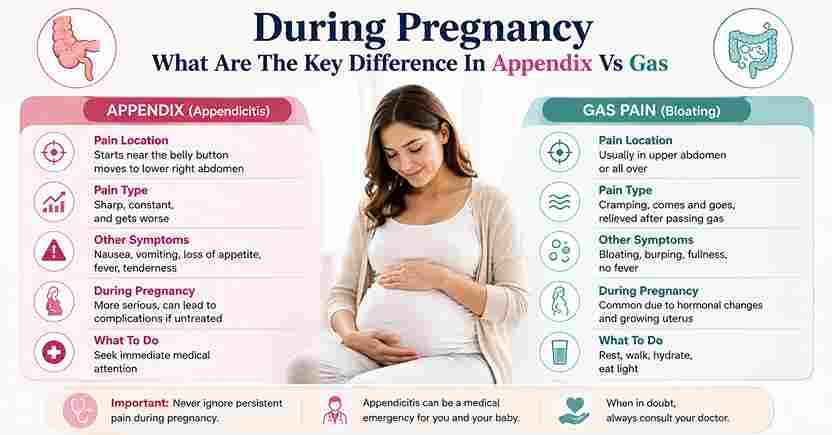
During Pregnancy What Are The Key Difference In Appendix Vs Gas
Pregnancy – As the uterus grows in size, it can push the appendix upwards, so pain might instead appear in the upper right or hip region instead of the lower right area. That change in location can make you think of gas, round ligament pain or heartburn, particularly if it arrives with bloating.
Nausea, lack of appetite and mild belly cramps flow into normal pregnancy symptoms. You may dismiss what is in fact early appendicitis as ‘another hard trimester day’.
That’s why monitoring digestive and pregnancy fluctuations is important. For instance, mention if the pain is constant and on one side, or gets worse with motion or if it feels unlike your regular gas or Braxton Hicks contractions.
Keep an eye on patterns like:
- Pain that is not relieved by flatus or bowel movement
- New unilateral tenderness that you can localize with a finger
- Fever, even low-grade, or chills
- New vomiting that follows pain, not vice versa
Pregnant patients are more likely to have atypical symptoms and significant complications if diagnosis is delayed, especially if the inflammation has been occurring for 24 to 72 hours.
Since imaging options are more restricted in pregnancy, specific details about timing, location, and what makes the pain better or worse can assist your care team in identifying appendicitis earlier instead of attributing it to normal pregnancy symptoms of gas discomfort.
In Older Adults Warning Sign
Appendicitis can present with softer, quieter symptoms in older adults. It can be mild, vague, or even dull enough that you or your loved one can still get up and walk around and eat a little. This low-key pattern is among the reasons diagnosis is often late in this group.
Rather than stabbing right-sided pain and obvious fever, you may experience confusion, low-grade fever, decreased appetite, or overall “not being themselves.” An otherwise energetic individual can remain in bed, appear less responsive, or walk with slowness and rigidity.
Because gas, constipation, and other chronic conditions are common in seniors, it’s easy to conclude this is ‘the norm.’ That’s an issue because the risk of rupture rises precipitously after one to three days of inflammation.
Here is a simple comparison to show how signs can differ:
| Feature | Typical younger adult pattern | Typical younger adult pattern |
| Pain pattern | Starts near belly button, then moves to lower right abdomen | Vague or widespread pain, not always clearly one-sided |
| Pain intensity | Often sharp and strong | Mild to moderate, sometimes dull |
| Fever | More likely, but not in everyone | May be low or absent |
| Digestive symptoms | Nausea, loss of appetite, sometimes vomiting | Mild nausea, poor appetite, maybe no vomiting |
| Behavior / mental changes | Usually alert, can describe pain clearly | Confusion, lethargy, or “not acting like themselves” |
Any new combination of tummy ache, delirium, and low-grade fever in an elderly individual ought to get your attention, even if they don’t yet appear that very “ill.
Since rupture can still take place as early as 36 hours from the initial warning signs, it’s better to be safe than sorry and get checked out, particularly if you have a family history of appendicitis or previous instances of mysterious right-sided pain.
What Else Mimics Appendicitis ?
A ton of other issues in your tummy can imitate appendicitis, particularly during the initial hours when pain is diffuse and around your mid-abdomen. You may experience stabbing gas pain and then fret it’s your appendix, as both can lead to cramping, bloating, and nausea.
Gas pain generally arrives in waves, can last anywhere from a few minutes to a few hours, and dissipates naturally once you fart or have a bowel movement. Appendicitis pain typically becomes more constant, acute, and migrates to the lower right.
Gastroenteritis (“stomach flu”) can give you crampy pain anywhere in your abdomen, along with nausea, vomiting, and loose stools. Unlike appendicitis, you often have diffuse, “all over” pain and obvious signs of infection, such as fever and body aches.
Ileus and intestinal obstruction both impede or halt the passage of food and gas. You can have bloating, persistent pain, and fecal smelling emesis. With ileus, the gut is slow; with obstruction, it is obstructed. Both can mimic appendicitis-level pain and require emergent treatment.
Gynecologic causes like ovarian cysts or ectopic pregnancy can mimic appendicitis because the ovaries and fallopian tubes lie near the appendix. There might be pelvic pain associated with your periods, abnormal bleeding, or pain with intercourse.
Urinary tract issues, like kidney stones or bladder infection, can cause jagged lower abdominal or side pain as well as burning urination, blood in your urine, or frequent urination.
Inflammatory bowel disease, Meckel’s diverticulitis, hernias and peritonitis all can cause severe localized pain, often with fever and rebound tenderness when you press on the abdominal wall.
| Condition | Key clues that differ from appendicitis |
| Gas pain | Comes and goes, shorter lasting, often eases after passing gas |
| Gastroenteritis | Diffuse cramps, diarrhea, often sick contacts |
| Ileus / obstruction | Marked bloating, little or no gas or stool, repeated vomiting |
| Ovarian cyst / ectopic | Menstrual changes, pelvic pain, possible vaginal bleeding |
| UTI / kidney stone | Burning urination, blood in urine, flank or back pain |
| IBD / Meckel’s / peritonitis | Chronic flares or sudden severe tenderness, sometimes prior history |
Beyond The Textbook Symptoms
You might not fit the “classic” appendicitis narrative whatsoever. Most don’t present with stabbing lower right side pain. You could experience a vague, dull ache close to your belly button, mild nausea, or what seems like hard-to-pass gas. Pain may lurk high in your abdomen, toward your back, or even down closer to the pelvis, particularly if your appendix happens to reside in an atypical location. This allows you to attribute it to food, stress, or a stomach bug.
Your personal health history influences the way symptoms manifest. If you live with diabetes, are on steroids, or have a weak immune system, a strong fever might not come first. If you’ve had abdominal surgery, scar tissue can alter your pain location and how gas migrates, so the typical “press and release” test for pain can be misleading.
Pregnancy can shift the appendix upward, so pain may sit higher than anticipated and feel more like heartburn or muscle strain. Timing and pattern, more than any one single symptom, are what matter. Gas pain frequently waxes and wanes and can relieve after having a bowel movement or passing gas.
Classic appendicitis pain is the kind that intensifies and remains, intensifies and remains, and intensifies and remains. Over 24 to 72 hours, it shifts from vague to sharp and constant. If a high fever over 38.3°C (101°F) presents with shaking chills, that’s a strong indication the infection could be spreading. You’re not just dealing with an inflamed appendicitis, but a legitimate risk of peritonitis and even sepsis, where your entire body responds to the infection.
For this reason, mechanized aids can assist. A simple checklist of when the pain started, where it migrated to, changes in fever, nausea, vomiting, bowel movements and your farting urges provides better clarity than memory alone. This is significant because an appendix can rupture in anywhere from 24 to 72 hours of first symptoms, and the risk of rupture increases about 5 percent every 12 hours after the initial 36.
Symptoms of peritonitis following a rupture usually are or include abdominal pain and tenderness all over, pain aggravated by any movement or touch, nausea, vomiting, bloating, diarrhea or constipation, an inability to pass gas despite a strong urge, as well as fever and chills. That blend is no longer ‘normal gas’ and requires immediate medical attention, even if you still feel capable of walking or talking through the pain.
Conclusion
Your body communicates loudly, even if it’s uncomfortable at the time. Gas pain isn’t consistent. It moves, is relieved with a bowel movement, or changes with food. Appendicitis pain will often sequester, intensify, and is accompanied by other red flags like fever, loss of appetite, or malaise that does not align with a normal crappy stomach day.
You don’t have to sort every symptom on your own. A quick consult with your doc, urgent care, or nurse line can save a lot of anxiety and time. In uncommon instances, it can save your life.
Take what you learned here as a roadmap, not a destination. When in doubt, consult a medical professional and receive definitive answers.
Frequently Asked Questions
How can you tell appendicitis symptoms from gas pain?
Gas pain usually gets better when you have passed gas, changed your position, or taken an over-the-counter medication. Appendicitis pain generally originates around your navel and radiates to your lower right abdomen, intensifying consistently and commonly accompanied by fever, vomiting, or anorexia.
Where is appendicitis pain usually felt?
You generally experience the appendicitis pain beginning near your belly button. Then it frequently shifts to the right lower part of your abdomen. The pain becomes sharp, constant, and worse when you walk, cough, or press on that area.
Can gas pain be as severe as appendicitis?
Gas pain can be uncomfortable or crampy. It tends to fluctuate and wane with movement or bowel habits. Appendicitis pain is more consistent and continues to worsen. If your pain is severe and unrelenting, you need urgent medical attention.
When should you go to the doctor for suspected appendicitis?
You should get emergency care if you have worsening lower right belly pain, especially with fever, nausea, vomiting, or loss of appetite. Don’t wait to see if it passes. A burst appendix is an emergency and can be fatal warning signs of appendicitis.
Can appendicitis symptoms be mild or unusual?
Yes. Certain individuals, such as kids, seniors, and pregnant women, could experience unclear or weak symptoms. Pain might not be in that classic lower right spot. Any new, unaccountable, intensifying belly pain deserves a visit to a care provider.
What other conditions can feel like appendicitis?
Conditions that can present and mimic appendicitis include gas and bloating, stomach viruses, constipation, urinary tract infections, kidney stones, ovarian cysts, and ectopic pregnancy. Only a medical exam, blood tests, and imaging can reliably distinguish.
Is it safe to treat suspected appendicitis pain at home or need to diagnose appendicitis?
No. Don’t try to manage suspected appendicitis at home with heat pads, painkillers or laxatives. These can conceal symptoms or aggravate a potential rupture. If you think it’s appendicitis, get to urgent or emergency care immediately.